Water is the first currency of the space economy.
Everyone repeats the phrase. Take it literally and it becomes a test with three parts, and the honest scorecard, reserves, price, exchange, is the story nobody writes.
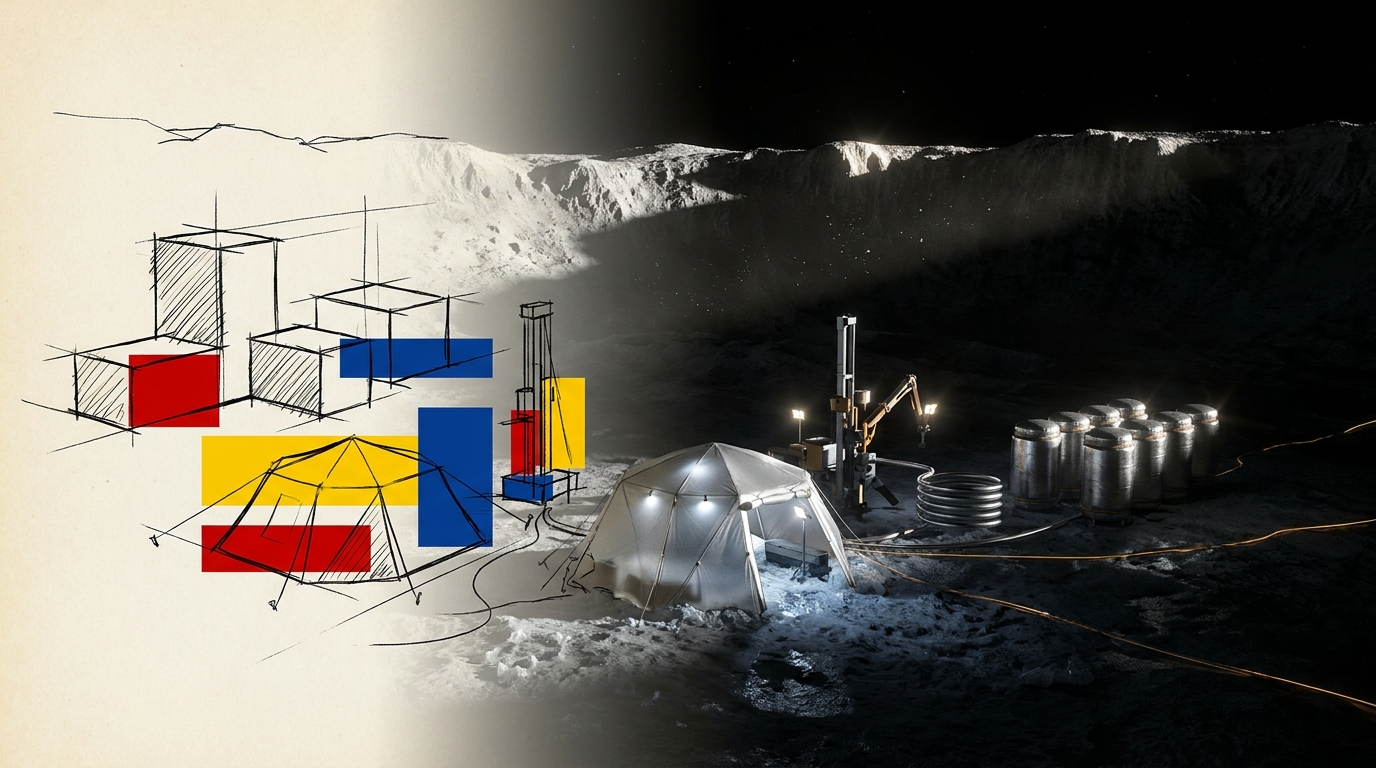
In part one of this series we argued that the first lunar mine is an operating system that happens to move regolith, and we labeled one claim a thesis on purpose: that water, not platinum, is the first currency the space economy will trade in. This essay pays that debt. Because the phrase has escaped into every pitch deck in the industry, and almost nobody who repeats it asks what a currency actually requires.
A currency is not a valuable substance. Gold was money only when everyone could agree what an ounce was, what it bought, and how it changed hands. A currency needs proven reserves behind it, a price the market can discover, and a mechanism that clears the trade. Three requirements. Lunar water, today, meets none of them.
That is not a debunking. It is a map. Each missing requirement is a named, fundable, datable piece of work, and the sequence they resolve in decides who owns the first real commodity market off Earth. Here is the scorecard, claim by claim, with every number labeled by how sure we actually are.
Why is a kilogram of water worth so much in space?
Because of the gravity well. Every kilogram used in space is first hauled out of Earth’s gravity, and the haul multiplies its price: in the transport model of the industry’s own architecture study, a kilogram of propellant bought on Earth roughly quadruples in cost by low Earth orbit and costs about thirty-six times as much delivered to the lunar surface (model figures, not market prices). Water made where it is used deletes that multiplier entirely.
And water is the one molecule that is three products at once: drinking water for crews, breathable oxygen once split, and hydrogen-oxygen rocket propellant, the same electrolysis for both. That is why the polar ice, not platinum, not helium-3, is the resource every serious lunar program aims at first. The demand side is real. Everything contested in this story sits on the supply side.
What does water have to prove before it is money?
Take the currency metaphor at its word. Money, any money, does three jobs: it stores value, it denominates value, and it moves value. A commodity graduates into a currency only when all three jobs have infrastructure behind them. Grain needed granaries, scales, and market squares. Oil needed surveyed fields, benchmark prices, and pipelines.
Run lunar water through that test and the slogan turns into a punch list. Reserves: one direct measurement, ever. Price: serious estimates two orders of magnitude apart. Clearing: a transfer demonstration that has not yet flown. Three jobs, three gaps, and, usefully, three different owners racing to close them.
The decisive competitor to lunar water is the customer’s own rocket.
How much water is on the Moon, really?
One direct subsurface measurement exists. In October 2009 the LCROSS mission steered a spent rocket stage into Cabeus crater and flew instruments through the debris plume. The result, published in Science: 5.6 percent water by mass, plus or minus 2.9 (Colaprete et al., 2010, peer-reviewed). Orbital instruments, starting with Chandrayaan-1 the same year, have mapped hydrogen signatures across the polar cold traps ever since. Detection is settled. Reserves are not: an ore grade measured at one point in one crater is a data point, not a deposit.
A mining industry would fix that with prospecting. Here is the prospecting scoreboard since that impact, and it is the part of this story the pitch decks skip.
Lunar Trailblazer: lost.
The orbiter built to map the form and abundance of lunar water launched on February 26, 2025, and controllers lost contact the next day. NASA declared the mission over on July 31, 2025. The map it would have made does not exist.
IM-2 / PRIME-1: tipped.
The first polar drill reached the south pole region in March 2025 aboard Intuitive Machines’ Athena, which landed on its side roughly 820 feet from its Mons Mouton target. The drill deployed; the mission ended early on depleted batteries. Some data came back. The assay did not.
VIPER: cancelled, revived, not yet flown.
The rover designed to prospect the ice directly was cancelled in 2024 over cost and schedule, then revived in September 2025 as a $190 million Blue Origin delivery, targeting late 2027, contingent on Blue Moon MK1’s first landing. The ore body’s surveyor is on the manifest, not on the Moon.
Sixteen years after LCROSS, the store-of-value column still holds a single assay. No bank issues currency against an unaudited vault. The first institution, public or private, to hold real resource maps of the polar cold traps holds something closer to the space economy’s founding ledger than any mine does.
Is lunar water mining economically viable?
Nobody knows, and the width of the disagreement is the finding. The serious studies of the same product, propellant from lunar water, reach conclusions two orders of magnitude apart. A market whose credible estimates span a factor of one hundred does not have a price. It has a debate.
| The study | What it concludes | The number that matters | Grade |
|---|---|---|---|
| Commercial Lunar Propellant Architecture (Kornuta et al., 2019) | A commercial polar water mine is buildable with thermal extraction, and near-term demand exists. | $2.4B/yr revenue on 450 t of propellant from 2,450 t of water; its hardest customer case closes near $500/kg. | Industry collaborative study |
| Cost breakeven analysis of cislunar ISRU (NASA BIG Idea) | Launching propellant from Earth beats lunar production, even under assumptions the authors call favorable to ISRU. | Cheapest lunar architecture: $78,000/kg delivered vs $40,000/kg from Earth, 97% more expensive. | NASA-funded parametric model |
| In-situ resource cost analysis (Texas Tech) | Moon-to-LEO water wins only while Earth launch stays expensive; deep-space staging is the durable customer. | Earth propellant at ~$2,000/kg to LEO closes the LEO case; lunar production must land under ~$3,000/kg to matter. | Academic cost analysis |
| Economics of in-space industry (Acta Astronautica) | The techno-economic literature itself is split between positive and negative verdicts on near-term viability. | The split IS the number: the field has not converged. | Peer-reviewed |
| Lunar propellant influence study (NASA, 1993) | Historical caution: the same product has looked imminent for over thirty years. | Projected lunar propellant at $3-10/kg “produced in quantity.” | NASA study, 1993 |
Strip the studies to their load-bearing assumption and they mostly disagree about one input: how cheap Earth launch gets, and how fast. Which turns the economics into a race between two falling cost curves, one run by the miners, one run by the customer’s own rocket. This is the same pattern the horse manure crisis teaches: a domain can dissolve underneath its solvers, and here the solvent has a name and a launch schedule. Whether the curves ever cross is exactly what reading your S-curve is for.
What has to exist before water can be traded in orbit?
A currency has to change hands. For water in space, changing hands means moving cryogenic liquids between vehicles in microgravity, and that has happened exactly once, inside a single vehicle: on Starship’s third flight, in March 2024, liquid oxygen moved from header tank to main tank under a NASA Tipping Point demonstration the agency’s reviewers judged successful.
The step that matters, two vehicles docking and one refueling the other, is targeted for no earlier than late 2026. And the scale required is unforgiving: Starship’s lunar lander needs roughly ten tanker launches to fill one depot for one Moon trip. Depots, boiloff management, custody transfer, metering: the market square of this economy is a construction site. Note who is building it. The refueling architecture is being proven by the launch companies, the same actors whose falling prices threaten the mine. The clearing house and the competitor are the same firms.
There is also no settled answer to WHERE the trade clears: low Earth orbit, the Earth-Moon Lagrange points, lunar orbit, or the surface. Each location favors a different seller. Refueling architecture is a competition without a dominant design, which is precisely what makes this moment interesting: the standard is still up for grabs.
What would a disciplined investor actually do with this?
Run the three questions any venture has to survive. Is it real? The demand is real and the deposit is plausible, but a market with one assay and no price has not yet proven it is real AS A MARKET. Is it winnable? Not by drilling first: the winnable ground right now is the data layer (prospecting) and the standards layer (where and how the trade clears). Is it worth it? Only on the timeline where lunar production cost beats Earth launch cost to the crossover, which is a timing question, not a mining question.
Sequence, not slogan. The currency test orders the work: prove reserves (prospecting data someone will pay for), enable price discovery (assay standards, delivery benchmarks), then build the clearing infrastructure (depots and transfer), and only then does the mine itself become the obvious investment instead of the brave one. Each stage de-risks the next, and each stage has a different natural owner.
And notice what every stage of that sequence runs on: the orchestration layer from part one. A commodity market needs machine-verifiable provenance, inventory, and custody at every transfer, executed by fleets no human can supervise in real time. The control plane is not adjacent to the currency. It is the mint.
Every claim above, labeled.
- The one direct assay: when the LCROSS impactor hit Cabeus crater in 2009, the instruments trailing it measured 5.6 percent water by mass, plus or minus 2.9 in the ejecta plume (Colaprete et al., Science, 2010, peer-reviewed). One number, one crater, one moment. Every reserve estimate since is extrapolation from orbit.
- Cryogenic propellant has moved between tanks in space once: Starship’s third test flight transferred liquid oxygen from its header tank to its main tank on March 14, 2024, under a 2020 NASA Tipping Point award. NASA’s own program page records the demonstration as completed, and the joint NASA Glenn analysis calls it successful. Inside one vehicle. Ship to ship has never been done.
- The chemistry is not the gap: the European LUWEX program already ran the complete chain, thermal extraction, vapor capture, purification, on icy regolith simulant under simulated permanently-shadowed-crater conditions. In a lab. The chain has never run where the ice is.
- The prospecting mission that would price the ore body: NASA cancelled VIPER in 2024 over cost and schedule, then revived it in September 2025 as a $190 million task order to Blue Origin. Landing target: late 2027, on the second Blue Moon MK1, with the delivery option gated on the first MK1 flight. The rover that would map the deposit has a ride, a date, and a condition.
- The exchange floor: SpaceX’s ship-to-ship propellant transfer demonstration is targeted no earlier than late 2026, and Starship’s lunar lander architecture needs roughly ten tanker launches to fill a depot for a single Moon trip. Orbital refueling is the plumbing of the entire water economy, and it is still a scheduled demo, not infrastructure.
- Water really is the first currency of the space economy, in the literal sense: the first commodity that could give cislunar activity a price system of its own. But a currency is a system, not a substance, and the system has three missing parts. The honest reading of the evidence is a sequence, not a slogan.
- The decisive competitor to lunar water is not another mine. It is the customer’s own falling launch cost. If Earth-to-orbit prices keep collapsing faster than lunar production costs can, the near-Earth market never opens, and the water economy retreats to the places Earth launch cannot reach cheaply: the lunar surface itself and deep space staging. That is a timing race, and it can be analyzed as one.
The currency test is the business plan.
“Water is the first currency of the space economy” survives its own audit, but only as a work order. Reserves: fund the map. Price: build the assay and the benchmark. Exchange: prove the transfer and win the standard. The phrase every pitch deck treats as a conclusion is actually the industry’s to-do list, in order.
And currencies are not made by chemistry. They are made by institutions: the entities that certify the vault, publish the benchmark, and guarantee the trade. Nothing in the Outer Space Treaty era has ever had to do those jobs three light-seconds from the nearest court. That is part three.
Three parts. This is the second.
The three questions people actually search.
How much water is on the Moon?
Exactly one direct subsurface measurement exists: the 2009 LCROSS impact found 5.6 percent water by mass, plus or minus 2.9, at one spot in Cabeus crater. Orbital data points to more ice in polar cold traps, but the resource map that would turn detection into proven reserves has not been made.
Why is water so valuable in space?
Because of the gravity well. Every kilogram used in space must first be launched out of Earth's gravity, which multiplies its cost roughly 4 times to low Earth orbit and roughly 36 times to the lunar surface in the standard transport models. Water made in space deletes launch mass: it is drinking water, breathable oxygen, and rocket propellant from one molecule.
Is lunar water mining economically viable?
Nobody knows yet, and the serious studies disagree by two orders of magnitude. An industry architecture study models a viable 2.4 billion dollar annual propellant market; a NASA-funded breakeven analysis found lunar propellant 97 percent more expensive than launching it from Earth. The deciding variable in both is the same: how cheap Earth launch gets.
You think this is a mining decision. It is a timing decision.
Copy the deal below into a DataRoom. Compare the cost curves, identify the hypothesis the investment depends on, and choose evidence that could challenge it.
Copy the deal. Mindrian kicks in.
I am evaluating an investment and I think the market narrative is doing my thinking for me.

The pitch: a venture that will mine water ice in permanently shadowed craters at the lunar south pole, split it into hydrogen and oxygen, and sell propellant in cislunar space. The deck quotes a $2.4 billion annual market, a $500-per-kilogram price point, and the phrase "water is the first currency of the space economy" appears three times.

What I actually know: exactly one direct subsurface assay of a polar crater exists, from an impactor in 2009. The three missions meant to map the resource since then were lost after launch, tipped over on landing, or cancelled and revived without flying yet. Serious cost studies for the same product disagree by two orders of magnitude. And the customer's own launch costs fall every year, which means my real competitor may be the customer's rocket.

Help me think about this properly. Do not evaluate the hardware. First tell me what kind of problem this is: an engineering bet, or a timing bet? Then find what has to become true, in what order, before lunar water clears as a commodity, and tell me which of those steps this venture actually controls.
Five moves, the timing question first.
Each command is copyable. Every one is a real MindrianOS move, documented in the catalog.
- 1Open a room and paste the deal
Ask what would have to be true for this market to exist before grading the hardware.
On the lunar water dealThe assumption to examine: three repetitions of a slogan is a narrative doing the diligence for you.
- 2Classify what kind of problem this is
An engineering bet, or a timing bet wearing a mining costume? Getting this classification right decides which analysis is even relevant.
On the lunar water dealThe hardware is not the open question. Every unknown that matters is a when, not a whether.
- 3Race the two cost curves
Maps where the technology sits on its S-curve and when entry stops being early, before you pay the pioneer tax.
On the lunar water dealThe question is not whether lunar water gets cheap. It is whether it gets cheap before Earth launch does.
- 4Find the assumption that splits the studies
Devil's advocate on the deck's numbers: the $2.4B study and the 97%-more-expensive study cannot both be right.
On the lunar water dealThey diverge on one input more than any other: the launch cost each one plugs in. That is the load-bearing assumption.
- 5Run the Ten-Questions investment gate
The thesis has to survive as a sequenced bet, not a slogan: what has to happen first, and who owns that step.
On the lunar water dealProspecting data first, price discovery second, the mine last. Fund the step the sequence is actually stuck on.
- LCROSS water measurement.Colaprete et al., “Detection of Water in the LCROSS Ejecta Plume,” Science 330, 463 (2010), the 5.6 ± 2.9% by mass figure: paper.
- Lunar Trailblazer. Launch, loss of contact, and end of mission: eoPortal mission record.
- IM-2 / PRIME-1. Landing attitude, distance from target, early end: NASA PRIME-1 mission page.
- VIPER revival. $190M CLPS task order, Blue Moon MK1, late 2027, option gating: SpaceNews and SatNews.
- Commercial Lunar Propellant Architecture. Kornuta et al., 2019: the $2.4B/yr, 450 t, 2,450 t, and $500/kg figures: full study (USRA).
- Cost breakeven analysis. NASA BIG Idea parametric study, the $78,000 vs $40,000 per kg and 97% figures are its stated baseline result: analysis PDF.
- Starship sensitivity. Texas Tech cost analysis of in-situ resources, the $2,000/kg and $3,000/kg thresholds and transport multipliers: analysis PDF.
- TEA literature split. Economics of in-space industry and competitiveness of lunar-derived propellant: Acta Astronautica; a 2026 open-access evaluation framework: Space and Planetary Resources.
- Flight 3 propellant transfer.NASA’s program statement and the joint NASA Glenn / SpaceX analysis: NASA HLS, NTRS 20250003325; ship-to-ship demo timing: mission record.
- Historical caution. 1993 NASA study projecting lunar propellant at $3-10/kg produced in quantity: NTRS 19930004795.
- Extraction chain demo. LUWEX integrated water extraction and purification under simulated PSR conditions: CORDIS record.
What does this change about your problem?
Bring a hard problem or a load-bearing hypothesis into a DataRoom. Connect the context, question the assumptions, and choose what to test next.