
The beam nobody has won.
Four rival architectures are fighting for the same job, and the fight has not settled. Here is what it looks like to stand inside an era of ferment while it is still happening, told through directed-energy weapons and one formal competition with a real deadline. Then: a dare to point the same question at your own field.
Every field eventually gets its dominant design: the one architecture the whole industry quietly agrees to build on, while the argument moves upstairs to who does it best. Directed-energy weapons have not gotten there. Not because nobody is trying. Because at least four different bodies are still competing for the exact same job, and none of them has been crowned.
That gap, between a field that has picked its architecture and one still arguing about it, is the single most expensive thing to misread in any competitive terrain. Call the winner too early and you optimize a shape that has not won yet. Miss that the winner is still open and you stop looking for the opening that only exists during ferment. Here is how to tell which one you are standing in, before you bet on an answer.
Everyone argues which laser wins. Nobody asks if a winner exists.
Put a room of engineers in front of the counter-drone problem and watch the reflex. Someone says fiber lasers have the best operational readiness today. Someone else says chemical lasers still hold the range record. A third points out that high-power microwave is the only thing that can down an entire swarm in one pulse instead of picking targets off one at a time. A fourth says solid-state is where the manufacturing money is actually flowing, roughly two out of every five dollars in the segment by some counts.
Three minutes in, the room is debating which architecture is better. Nobody has asked the only question that would tell them whether that debate even has an answer yet: has a dominant design emerged here at all, or is this still an era of ferment where the debate itself is the evidence?
Four confident answers, radiating from the same unresolved question. That is not a disagreement about facts. It is the sound an era of ferment makes.
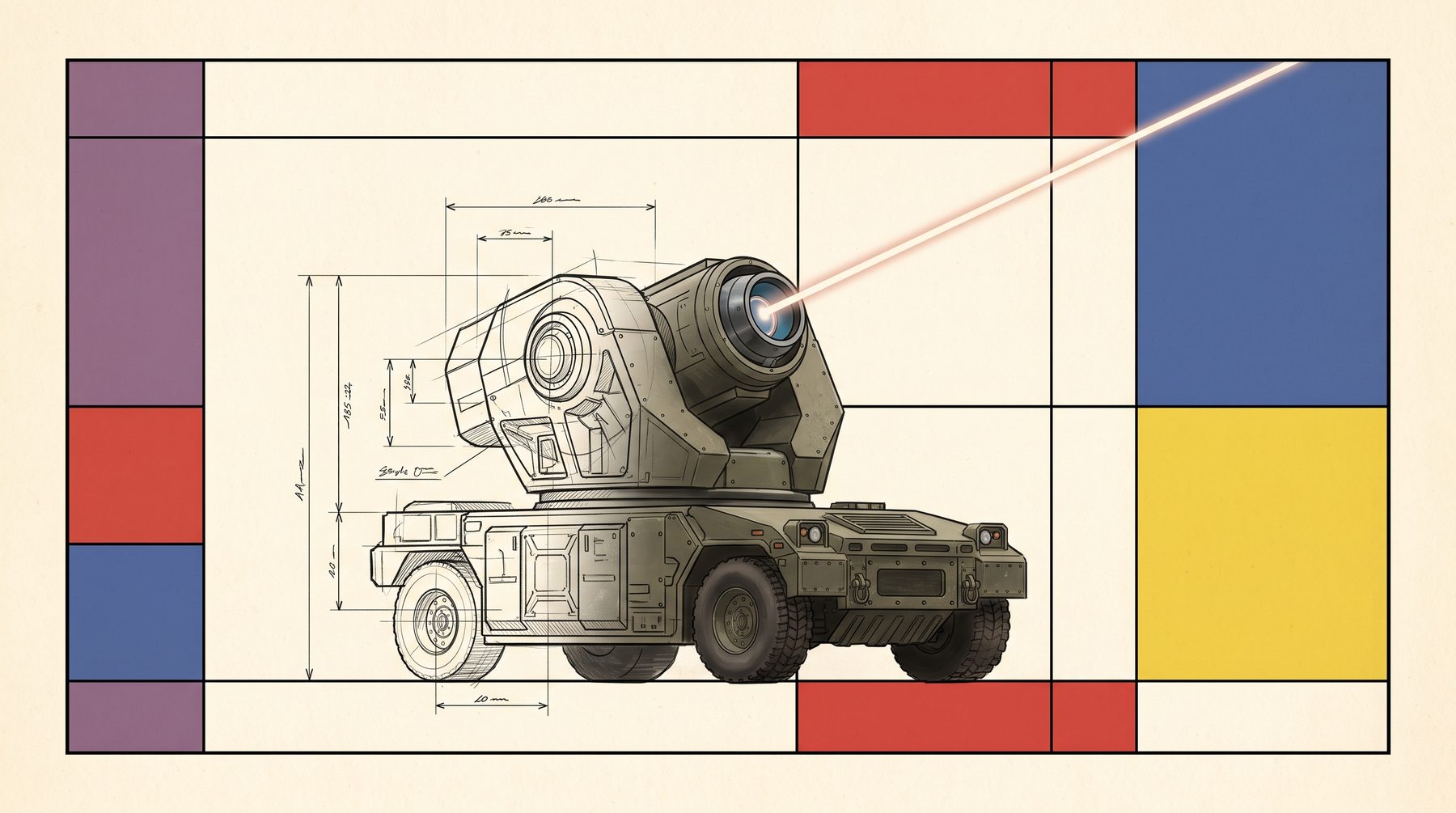
None of these has stopped changing.
A directed-energy weapon is not one technology wearing different badges. It is at least four separate architectural bets, each answering a different constraint and undervaluing another:
- Solid-state lasers. The manufacturing and investment center of gravity right now, reportedly around two-fifths of the technology segment in 2025. Compact, but historically weaker on raw range than chemical designs.
- Fiber lasers. Widely cited as having the highest operational readiness of the four today, the architecture behind fielded, publicized systems such as Iron Beam. Readiness is not the same as convergence: the other three species are still funded and still evolving in parallel.
- Chemical lasers. The longest operational history and the deepest range envelope of the four, at the cost of fuel logistics and a larger footprint that the newer electric architectures are built specifically to avoid.
- High-power microwave. The only species built to answer a different question entirely: not one target at maximum range, but many targets at once, the counter-swarm case none of the point-defense lasers were designed to solve.
Programs across 2025 and 2026, publicly named things like Iron Beam, HELIOS, DE M-SHORAD, DEIMOS, SHIELD, and ATHENA, are running side by side across more than one of these architectures at once, by more than one program office, for more than one branch of service. That parallelism is not noise. It is exactly what an era of ferment looks like from the inside, before anyone has the benefit of hindsight.
Compare that to a real dominant design: one architecture, everyone building on it, the argument having quietly moved to who executes it best. Here the argument is still about which body gets to exist. The US Army’s own Enduring High Energy Laser program is a formal effort to down-select from a much larger pool of prototypes to one winning design across 2025 into fiscal year 2026. That is the ferment-to-dominant transition, scheduled on a real government calendar, arriving before anyone outside the program knows which body wins.
A dominant design ends the argument about which architecture. An era of ferment is the argument, still running.
How to know you are still inside an era of ferment.
Solid-state, fiber, chemical, and high-power microwave are not four stages of one design maturing. They are four different bodies competing to become the answer, each one still changing its own architecture in public.
One program is judged on range, another on beam quality, another on how many drones it can hit per minute, another on how little power it draws. In a dominant design, the industry has already agreed what to measure. Here, the measuring stick is still being argued over.
Nobody has built an ecosystem of suppliers, doctrine, and training so deep that leaving it would be expensive. That lock-in is exactly what a dominant design produces, and it has not happened yet.
Atmospheric propagation caps one architecture, thermal management caps another, power generation caps a third. A dominant design has ONE reverse salient everyone is racing to fix. An era of ferment has several, unresolved, at once.
Even a real, publicized operational win for one architecture has not (yet) ended the argument the way a dominant design ends it. The other three species are still funded, still competing, still evolving.
That is the tell that separates this from an argument with no end. The US Army's own Enduring High Energy Laser program is explicitly built to pick ONE winning design from a much larger pool of prototypes across 2025 into FY2026. The ferment-to-dominant transition is not hypothetical here. It has a date. It just has not happened yet.
Wealth is not the tiebreaker. Organization is.
The instinct in any era of ferment is to assume the best-funded program wins. Michael Horowitz, a political scientist and director of the Perry World House whose book The Diffusion of Military Power (Princeton University Press, 2010) studies exactly this question, argues that adopting a new military technology takes both money AND organizational capacity, and that bureaucratic inflexibility can hand the real edge to smaller, more agile actors instead of the largest budget in the room. Wealth is not enough.
Horowitz has also argued that some of the most consequential new capabilities behave less like a single weapon and more like a general-purpose technology, writing in the Texas National Security Review in 2018 that AI “seems much more akin to the internal combustion engine or electricity than a weapon”: dual-use, diffusing everywhere at once rather than staying contained to one platform. More recently he has used the phrase precise mass (discussed here) to describe how AI and autonomy, layered onto precision-guidance technology that has already diffused globally over fifty years, plus ordinary commercial manufacturing, lets almost any organized actor generate some real precision-strike capability, not just the wealthiest one.
That is the whitespace this era of ferment is actually about. Not who builds the hottest beam. Who builds the dual-use photonics, power-electronics, and beam-control stack underneath every architecture, and who is organizationally quick enough to field it while the field is still open. The Christensen Question sharpens this: what dimension has the field been undervaluing? Here, it is cost-per-engagement.
A laser shot costs a few dollars of electricity. A single kinetic interceptor historically runs on the order of fifty thousand dollars, and its magazine empties one round at a time. The laser’s magazine is limited only by how much electrical power you can generate, not by how many rounds you loaded this morning. That undervalued dimension, not raw beam power, is where the next mover actually wins. It is the same move the brick and the molecule made in Dominant Design: The Brick That Won, except that piece already had its winner. This one does not, yet, which is exactly why the opening is still there to find, alongside the rest of the command catalog.
Fermentation happens outside any one domain.
Directed energy is one field standing in an era of ferment. It is not the only one, and it is not even the only one running on the same underlying physics. Fusion energy has its own unresolved rival architectures, no military angle required: two competing families of confinement, and neither has been crowned.
Tokamaks (ITER), stellarators, magnetic mirrors, and field-reversed configurations all hold the plasma in place with magnetic fields, given time to sustain the reaction.
Laser-driven designs (NIF, which hit net energy gain in 2022) compress a fuel pellet so fast that its own inertia holds it together long enough to fuse. Per 2025 analysis it still lags magnetic confinement in private investment and technology maturity.
Here is the bridge back to this piece’s own subject: inertial confinement fusion runs on the same underlying laser, photonics, and beam-control stack as directed-energy weapons. A real dual-use link, not a stretch, per the MIT PSFC comparison of magnets vs. lasers, a 2025 survey of inertial-confinement approaches, and an overview of the competing fusion approaches. Wherever the underlying stack diffuses, the era of ferment follows it, and it does not stay inside one domain.
You think you know which architecture wins. Do you know if a winner has even been decided?
Copy the example below into a DataRoom. Ask whether a dominant design has emerged, compare the evidence for competing paths, and keep unresolved questions visible.
Copy the story. Classify before you commit.
I want to classify a field correctly before I pick a side in it, and I am not sure anyone has agreed on the winner yet.

The domain: directed-energy weapons. [OR DESCRIBE YOUR OWN FIELD IN ONE OR TWO LINES]

Here is what I notice. At least four rival architectures are competing for the same job right now: solid-state lasers, fiber lasers, chemical lasers, and high-power microwave systems. Each one answers a different constraint well (range, beam quality, power draw, or hitting many targets at once) and each one fails a different one. Nobody has converged. Real programs are running side by side, and at least one formal government competition exists specifically to down-select from a much larger pool of prototypes to one winning design, on a dated calendar.

Help me think this through properly. First classify it: has a dominant design already emerged here, or is this still an era of ferment with the winner unsettled? Do not jump to picking a favorite. Then tell me what a solution here must deliver regardless of which architecture wins, and where the real opening is - the move three steps ahead, not a slightly hotter beam.
Six moves, classification first.
Each command is copyable. Every one is a real MindrianOS move, documented in the catalog. The grey notes track the running example: directed-energy weapons.
- 1Open a room and paste the story
Map the technology life cycle and its competing designs before choosing a preferred direction.
On directed-energy weaponsAsk whether a dominant design has emerged before declaring any laser the best.
- 2Classify the life-cycle stage
Era of ferment, or has a dominant design already emerged? The single highest-leverage call in the whole project.
On directed-energy weaponsFour rival architectures, no converged winner: the beam has not picked its body yet.
- 3Name what the solution must deliver, regardless of architecture
The Christensen Question: what dimension does the current thinking undervalue, that could decide the winner?
On directed-energy weaponsCost-per-engagement and magazine depth. A laser shot costs a few dollars of electricity; one kinetic interceptor runs on the order of fifty thousand dollars, and the magazine is limited only by how much power you can generate, not how many rounds you loaded.
- 4Find the lagging component
The reverse salient: the one part of the system holding every architecture back from its own promise.
On directed-energy weaponsAtmospheric propagation. Haze, cloud, and dust scatter and absorb a beam differently depending on wavelength and power, and that physical ceiling differs by architecture rather than by budget.
- 5Find the opening nobody is chasing
Maps the terms of the current competition and surfaces the gap sitting just past it.
On directed-energy weaponsThe opening is rarely a hotter beam. It is the dual-use photonics, power-electronics, and beam-control stack underneath every architecture, the move three counters ahead of the current fight.
- 6Stress-test the assumption nobody said out loud
Names the load-bearing belief in the room and asks what breaks it.
On directed-energy weaponsThe assumption: the wealthiest program wins. Diffusion theory says otherwise -- organizational agility, not budget alone, decides who fields a capability first.
- MindrianOS Brain. The era-of-ferment vs. dominant-design contrast, the Christensen Question, and reverse-salient framing are drawn from the teaching corpus (Utterback & Abernathy; Anderson & Tushman).
- Utterback & Abernathy; Anderson & Tushman. The era-of-ferment / dominant-design / era-of-incremental-change model. Overview: Dominant design. Full treatment: Anderson & Tushman (1990).
- Directed-energy weapons background. Directed-energy weapon and Iron Beam (Wikipedia overviews).
- Michael Horowitz. Professor of political science and director of the Perry World House. The Diffusion of Military Power (Princeton University Press, 2010); the dual-use framing from his 2018 Texas National Security Review commentary; the “precise mass” framing from his Nov/Dec 2024 Foreign Affairs essay (also discussed on the CFR President’s Inbox podcast).
- Program and market figures. Solid-state market-segment share (SNS Insider), fiber-laser operational-readiness claims (Defence Science Review), the named 2025-2026 programs (IMARC Group), the Army Enduring High Energy Laser down-select timeline (Defense News), and the per-shot cost contrast (Migflug) are drawn from defense-trade-press and market-research coverage current as of this writing.
- Fusion confinement (era of ferment, non-military). MIT PSFC, “The Race to Fusion Energy: Magnets vs. Lasers” (May 2025); The Fusion Report, 2025 analysis of inertial-confinement approaches; US Fusion Energy, overview of competing confinement approaches.
What does this change about your problem?
Bring a hard problem or a load-bearing hypothesis into a DataRoom. Connect the context, question the assumptions, and choose what to test next.