Dominant design: the brick that won.
In every technology, one architecture quietly wins and everyone agrees to build on it. Miss that moment and you optimise the wrong thing for years. Here is the pattern, told through a toy brick and a Nobel-winning molecule that learned the same trick.
Pick up a LEGO brick made this year and snap it onto one made in 1958. It fits. Not approximately, exactly. Two generations of engineers, a near-bankruptcy, and a hundred thousand product variations later, the one thing nobody was allowed to touch was the coupling: the studs on top, the tubes underneath, the precise grip between them.
That refusal to change one small interface is not a manufacturing footnote. It is the most strategic decision the company ever made, and it has a name. The brick is a textbook case of a dominant design, and learning to see dominant designs, before they finish forming, is one of the highest-leverage skills in innovation. It is also, quietly, what separates a field that compounds from one that thrashes.
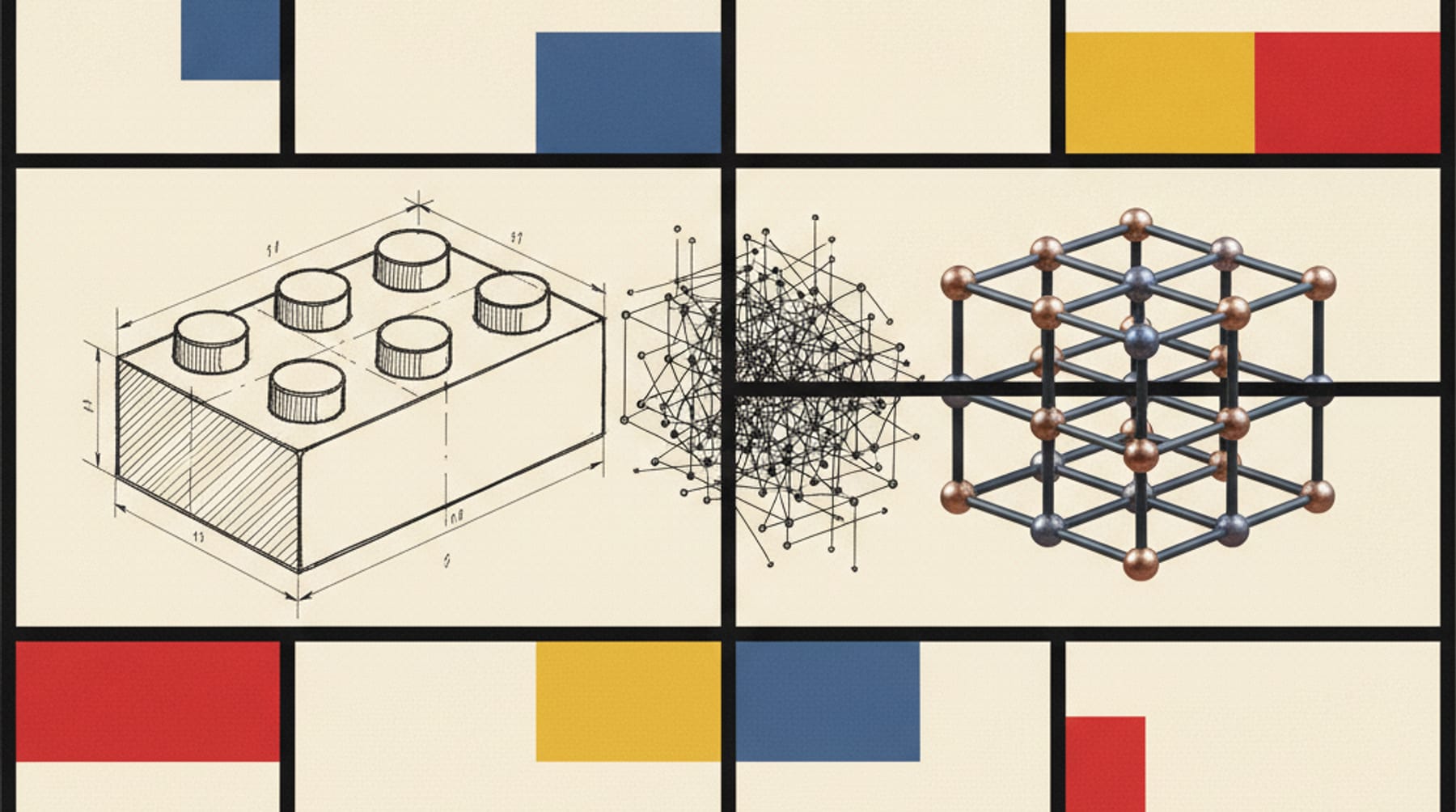
Fix one coupling. Let everything else explode.
A dominant design is a deal. The field agrees to freeze one interface, and in exchange it gets a combinatorial playground on top. Standardise the stud-and-tube and you get every set ever made. Standardise the node-and-linker and you get, as we are about to see, more than a hundred thousand new materials. Watch the move happen:
Left: a few standard parts. Right: a framework you can design on purpose. The coupling in the middle is the whole invention. Everything downstream is variations.
Ferment, then a winner, then a long polish.
The idea comes from Utterback and Abernathy, and from Anderson and Tushman. A new technology opens in an era of ferment: rival forms compete and nobody knows which will win. Then one architecture emerges as the dominant design, not because it is the most advanced, but because it balances practicality, cost, and acceptance well enough that the whole industry adopts it. After that comes an era of incremental change: a long stretch of making the winner better, cheaper, and faster.
You already live inside dozens of them. Every USB plug fits every USB port anywhere on earth because a dominant design settled the question. The QWERTY keyboard, the shipping container, the 1958 brick: each one is an interface that stopped changing so that everything around it could. As Baldwin and Clark showed, that is the power of modularity: freeze the connection, and you unlock the parts.
A dominant design is not the best idea. It is the one everyone agrees to build on.
How to know a dominant design has locked in.
Parts made years apart still fit. The fight is no longer about the architecture itself; it has moved to everything bolted on top of it. When the coupling goes quiet, a winner has been chosen.
Once the coupling is fixed, the number of things built on it climbs fast. Few rules underneath, endless combinations above. A handful of standard parts, a catalogue that never ends.
Tools, training, suppliers, and complements all standardise around the design. Leaving it stops being one company's decision and becomes expensive for everyone at once. That shared cost is the lock.
The era of macro-invention ends and an era of incremental change begins. Better, cheaper, faster, smaller. Rarely different. Progress turns from leaps into polishing.
Complementors arrive: accessories, standards bodies, a supply chain. They did not invent the design, but now they have every reason to keep it exactly where it is.
A dominant design is the one that balances practicality, cost, and acceptance, not the most advanced option in the room. The best idea and the winning idea are often not the same idea.
A molecule just learned the brick’s trick.
For most of chemistry’s history, new materials were found, not designed. You mixed things, you got lucky, you wrote it down. An era of ferment with no dominant design, running for a century. Then a coupling appeared. Join a metal node to an organic linker with a strong bond, and you get a crystalline cage you can plan in advance. Swap the linker and the cage predictably grows or shrinks. It is the stud-and-tube of chemistry.
This is reticular chemistry, and in 2025 it won the Nobel Prize in Chemistry for Omar Yaghi, Susumu Kitagawa, and Richard Robson, for the metal-organic frameworks (MOFs) it builds. Yaghi defines the field as stitching molecular building blocks into extended structures by strong bonds. He has put it more plainly too. He wanted, he told New Scientist, to make materials one molecule at a time, like programming molecules like Lego. That is not a journalist’s metaphor. That is the inventor describing his own field.
And then the brick’s pattern played out exactly. Once the coupling held, in his lab’s landmark 2003 Nature paper on reticular synthesis, the variations exploded. Yaghi made sixteen versions of one framework by swapping linkers, like swapping bricks. Today more than a hundred thousand MOFs have been built, with one gram holding the surface area of a football field. They harvest water from desert air and pull carbon dioxide out of the sky. The field crossed from discovery to design, which is precisely what a dominant design lets a field do.
What, in your domain, is the dominant design that needs examining?
Every field has its 1958 brick, somewhere. A coupling quietly hardening into the standard everyone builds on. Or an era of ferment about to pick a winner while most of the room is still arguing about features. The question worth your week is not what should I build. It is:
In my research, in my market, in my lab, has a dominant design already locked in, or is the winner still unsettled, and where does that put the real opening?
If you research new materials, that question is live right now. If you are anywhere else, it is just as live and far less examined. So examine it.
And if you want to watch a dominant design collapsing in real time, battlefield medicine is living it right now.
Copy this. Fill in your field. Paste it into MindrianOS.
I want to read the timing in my own field correctly, and I am not sure I have.

My domain: [DESCRIBE YOUR FIELD IN ONE OR TWO LINES - what you research or build, and the thing everyone seems to be converging on].

Here is what I notice. For a long time progress here came the slow way, by trial and discovery. Lately a single architecture, interface, or standard seems to be winning, and more and more of the work is just variations snapped onto it.

It reminds me of the toy brick that fixed one stud-and-tube coupling in 1958, so that every later brick still fits every earlier one - the interface won, and the sets exploded. It also reminds me of reticular chemistry, where a metal node joined to an organic linker became the coupling that turned material discovery into material design, and over a hundred thousand frameworks followed.

Help me think this through. First: in my field, has a dominant design actually emerged, or is this still an era of ferment with the winner unsettled? Do not jump to a product. Then place it on the S-curve, show me what is driving it, and tell me where the real opening is - the move three steps ahead, not a slightly better version of what already won.
Six moves, timing first.
Each command is copyable. Every one is a real MindrianOS move, documented in the catalog. The grey notes track the running example: reticular chemistry.
- 1Open a room and paste your field
Larry does not grade your idea yet. He maps the life cycle first, because timing decides what counts as a good move.
On reticular chemistryThe brick and the framework start as the same question: which coupling are people quietly agreeing to build on?
- 2Spot the dominant design
Utterback and Abernathy, applied to your domain. Has the architecture locked in, or is the field still bubbling with rival forms?
On reticular chemistryNode-and-linker is to MOFs what stud-and-tube is to the brick: the interface that stopped changing so everything else could move.
- 3Place it on the S-curve
Early ferment, locked-in growth, or a design ripe for disruption. The clock position changes the whole strategy.
On reticular chemistryReticular chemistry crossed from discovery to design around 1999 to 2003. That crossing was the window worth standing in.
- 4Borrow the pattern from another field
Same structure, different industry. Cross-domain analogy is where the eureka actually hides.
On reticular chemistryThe brick taught the molecule nothing directly. But the shape of the story - one coupling, then combinatorial explosion - repeats everywhere.
- 5Find the opening nobody is working
Maps the terms of competition and surfaces the unaddressed gaps sitting just past the current fight.
On reticular chemistryThe opening is rarely a better framework. It is the application three couplings ahead that the incumbents cannot see yet.
- 6Turn signals into a position
Climbs from scattered observation to a timing thesis you can defend, act on, and keep watching.
On reticular chemistryYou leave with a thesis and a standing watch, not a hot take you have to defend forever.
- MindrianOS Brain.The dominant-design model (era of ferment, dominant design, era of incremental change), the definition as an architecture adopted because it balances practicality, cost, and acceptance, the USB example, network effects and switching costs, and modularity. Drawn from the teaching corpus (Utterback & Abernathy; Anderson & Tushman; Baldwin & Clark).
- 2025 Nobel Prize in Chemistry. Awarded to Susumu Kitagawa, Richard Robson, and Omar M. Yaghi for the development of metal-organic frameworks. Official summary.
- Reticular synthesis.Yaghi, O. M., O’Keeffe, M., Ockwig, N. W., et al. Reticular synthesis and the design of new materials. Nature 423, 705-714 (2003). Nature.
- The Lego quote. Omar Yaghi, interview, New Scientist (2025): “Nobel prizewinner Omar Yaghi says his invention will change the world”.
Ready when you are. Install MindrianOS. Start thinking with Larry.