The Moon’s first mine will be run by AI agents.
But not the way you think. A MindrianOS point of view on where the real bottleneck in space resources actually sits, and why it is not the machine you can photograph.
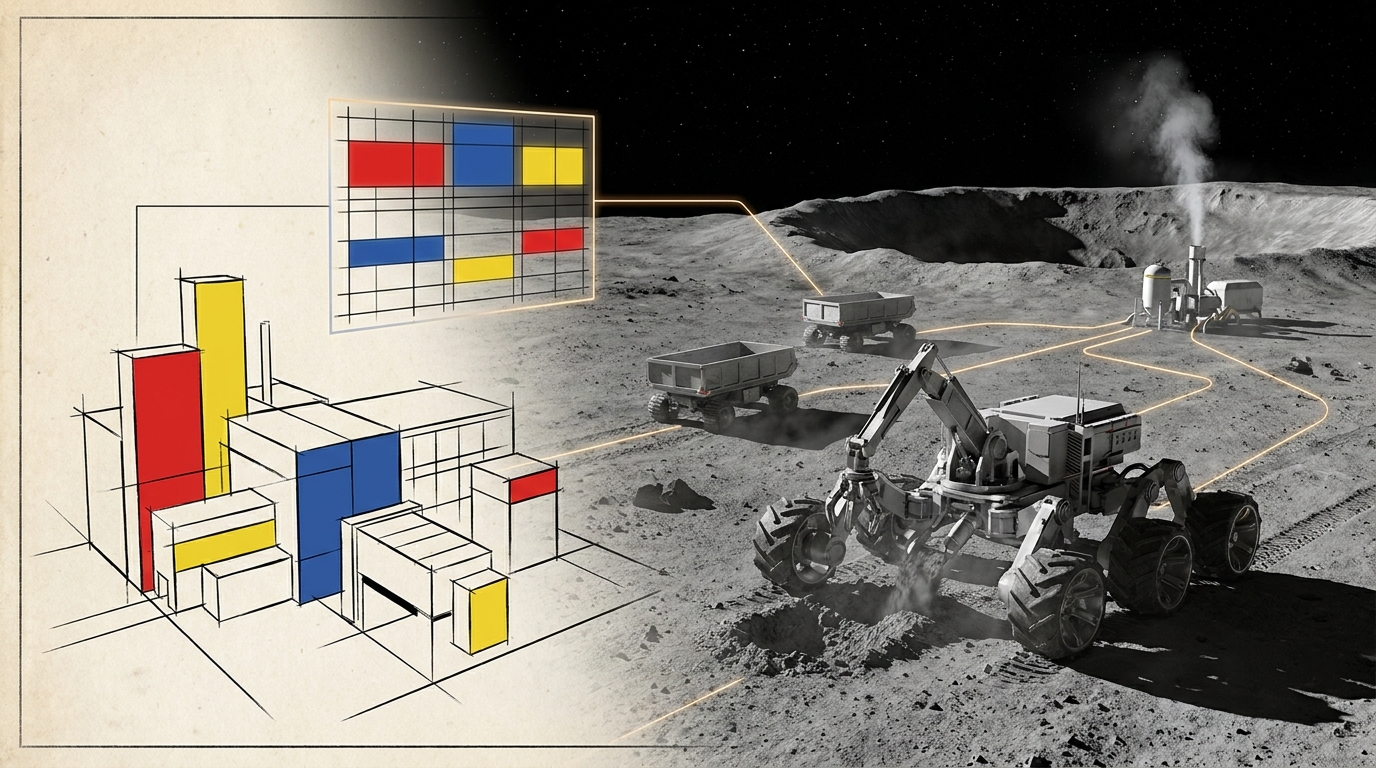
The first mine on the Moon will not begin with a human operator pulling a lever from Earth. It will begin with a machine deciding whether it has enough power to heat frozen regolith, whether its wheels are losing traction, whether a dust-contaminated valve can wait another cycle, and whether a kilogram of recovered water should go to life support, oxygen production, or a propellant depot.
That is not merely mining. It is autonomous industrial operations at the edge of human reach.
Almost every story written about lunar and asteroid mining fixes its gaze on the wrong object. It looks at the drill, the six-legged robot, the refinery, the rocket, the hardware you can photograph. That instinct is understandable, and it is exactly the instinct a disciplined theory of innovation tells you to distrust. In every large technological system that has ever scaled, progress was never gated by the most advanced component. It was gated by the least advanced one that everything else depended on.
The historian Thomas Hughes gave that lagging component a name: the reverse salient. And once you learn to look for it, the question “who will build the first Moon mine?” quietly rearranges itself into a far more useful one.
The reverse salient nobody is photographing.
Hughes studied how electrification, and other great systems, actually grew. A system expanding toward a goal does not advance as a smooth front. Some components fall behind or fall out of line, and growth of the entire enterprise is hampered until that lagging piece is resolved. The breakthrough, when it comes, is rarely a better version of what was already working. It is the resolution of the one constraint that was holding everything else hostage.
Electrification stalled for decades not on generation but on the cost of long-distance transmission. Electric vehicles stalled not on the car but on charging deserts. In each case the temptation is to keep improving the component that is already fast, to optimize the wrong subsystem, while the actual bottleneck sits somewhere less glamorous, waiting. So apply the same discipline to the Moon. What is the reverse salient of space resource extraction?
It is not the excavator: the CUMT six-legged robot is a serious answer to moving in near-weightless, unstructured terrain, demonstrated as a working prototype. It is not the refinery, either: the LUWEX chain has already demonstrated a complete water process, turning icy regolith simulant into usable water under simulated lunar conditions, demonstrated in the lab. And it is not the launch: reusable rockets and cheaper commercial components have already collapsed the cost of getting a spacecraft into deep space.
The reverse salient is the layer that makes all of those things act as one system, in a place where no human can supervise them in real time. It is coordination. It is the operating system.
It is not merely mining. It is autonomous industrial operations at the edge of human reach.
Why the OS, and not the robot, is the constraint.
This is not a rhetorical flourish. It is what NASA’s own program choices already say. Because of Earth-Moon communication delay and intermittent line of sight into permanently shadowed craters, the agency is not building toward a human at every valve. Its own excavation robot, the Infrastructure Pilot Excavator, is designed to run as an autonomous agent from the start, and its Lunar Autonomy Challenge is a standing invitation for outside teams to write the software that decides its moves without a human in the loop.
Separate NASA-funded research has already gone further than a single robot: six robots, playing the roles of scouts, excavators, and haulers, coordinated autonomously for hours on a simulated lunar site, dividing excavation work and handing material off between machines without a person choosing each move. The machines are also expected to share common, swappable modules, so a fleet can repair itself instead of waiting on a shipment from Earth, and to navigate with onboard positioning in an environment with no GPS. All of that while the site’s own energy budget grows from a pilot system in the single digits of kilowatts, to an early full-scale plant in the 40 to 100 kilowatt range, to hundreds, even low thousands, of kilowatts at industrial scale (NASA ISRU power studies).
Read that list again and notice what it actually describes: geology, rover state, power, thermal limits, inventory, maintenance, communications, and mission risk, all interdependent, all changing continuously, none of them controllable by a joystick from Houston. That is not a robotics problem with a software attachment. It is a software problem wearing robotics.
Every physical subsystem in that architecture is advancing quickly. The drills work. The refineries work in the lab. The robots move. The one component that does not yet exist as a mature, integrated capability is the control plane that unifies them into a single operable enterprise. Call the missing category what it is: a Space Resource Operations OS, a graph-native control plane that holds the whole system as one connected model, geology to rover state to power to thermal limits to inventory to maintenance to mission risk, and lets bounded, explainable agents plan, dispatch, recover, and prioritize inside it.
MindrianOS does not build drills, rockets, or refineries, and this essay is not a pitch that it will. But the underlying problem, a graph that knows WHEN to call WHICH capability, in WHAT sequence, under which constraints, is the exact problem MindrianOS was built to solve in a completely different domain: matching a venture room to the right thinking method at the right moment, instead of one bigger brain trying to do everything at once. The orchestration layer a lunar mine needs and the orchestration layer a DataRoom needs are structurally the same category of software. Someone still has to build the mining one. This essay is a bet on what shape it will take.
How to know you have an orchestration problem, not a hardware problem.
The drill outperforms its spec. The thermal system holds. The rover navigates cleanly. And still nothing is actually running, because nobody built the layer that decides which of those systems gets the next watt when two of them want it at the same moment.
Budgets fund the drill team, the power team, the comms team. Nobody owns the seams between them, so the seams are where the operation actually fails. If a line item in your plan is titled “integration” and staffed last, that is the reverse salient introducing itself.
A few seconds of light-speed lag will not stop a joystick by itself. Losing the line of sight for hours at a stretch will. The number that matters is not the round trip. It is how long the site has to act completely alone.
Nobody markets a lunar excavation control plane the way they market a rover or a drill. That silence is not evidence the problem is solved. It is evidence nobody has claimed the category, which is exactly where the whitespace sits.
Is this a problem worth solving, or just an interesting one?
It is worth being honest here, because the methodology behind this insists on it. A validated problem worth solving has to clear three tests: it must be Real (it genuinely exists), Winnable (it can actually be solved by whoever takes it on), and Worth It (the value justifies the effort). Plenty of space-mining narratives fail the third test badly. The “trillion-dollar asteroid full of platinum” story assumes you can ship raw metal down a gravity well and sell it at a profit, which is mostly fantasy accounting.
The orchestration problem passes all three, and in a more interesting way than the metals story ever did. It is Real because NASA has already written the requirement down: supervised autonomy, coordinated fleets, self-repair, energy-aware operation. Nobody has to speculate that the need exists. It is Winnable because it is fundamentally an information-systems problem, modeling, scheduling, provenance, constraint reasoning, not a new law of physics. The hard parts are things software has already learned to do in other high-stakes, partially observable domains.
And it is Worth It because the actual business of the early space economy is not exporting material to Earth. It is not having to launch material off Earth in the first place. Water is the commodity that matters, drinking water, breathable oxygen, radiation shielding, and rocket propellant, precisely because every kilogram made in place is a kilogram nobody has to lift out of a gravity well. That reframes the whole endeavor as the first extraterrestrial supply chain, and supply chains do not run on drills. They run on inventory, contracts, provenance, delivery, and allocation, or they run on nothing.
Demonstrated, planned, and thesis, kept separate on purpose.
The reason this conversation feels stuck on hardware is that it is answering the wrong question, “what machine do we build?”, when the more useful question is what has to be true for a mine no human can operate to run itself responsibly? Answering that honestly means separating what has been demonstrated from what is merely planned, and both from what remains a commercial thesis. An agent that cannot tell you which of its beliefs are measured, which are inferred, and which are assumed is not an agent you should trust with the last kilowatt.
- A complete water process chain, thermal extraction, vapor capture, cold-trapping, liquefaction, purification, already ran end to end on icy regolith simulant under simulated permanently-shadowed-crater conditions. Germany’s DLR led the integrated demonstration inside the European LUWEX program. Every stage a lunar mine needs has been chained together once, in a lab, not on the Moon. That gap is the whole subject of this essay.
- A research team at China University of Mining and Technology unveiled a six-legged prospecting robot in March 2025, three wheel-tipped legs and three claw-tipped legs, built to keep traction on loose, uneven, low-gravity ground. It already walks, anchors, and grips on simulated asteroid terrain in the lab. Coverage here. It is a genuinely clever body. A body only executes decisions; it is not the coordination layer that decides what it should be doing.
- A self-funded startup can now reach deep space on a shoestring, and lose the mission to a mundane systems failure rather than a law of physics. AstroForge launched Odin on February 26, 2025, targeting the near-Earth asteroid 2022 OB5. The probe made it roughly 270,000 miles from Earth before contact faded for good in early March. AstroForge’s own post-mission debrief points to a likely solar-panel deployment problem that dropped Odin into a low-power safe mode, possibly compounded by an uncontrolled tumble that kept its antenna from locking onto Earth. Not a dramatic deep-space catastrophe. A systems failure, on a spacecraft nobody could reach in time to fix it.
- NASA is not designing this around a human at every joystick. Its own excavation robot, the Infrastructure Pilot Excavator, is built to run autonomously, and the agency’s Lunar Autonomy Challenge is explicitly asking outside teams to write the software that decides its moves without a human in the loop. Separate NASA-funded work has already demonstrated six robots, scouts, excavators, and haulers, coordinating autonomously on a simulated lunar site for hours at a time.
- The energy budget is the plan’s own admission of what actually gates it. NASA’s ISRU studies put the smallest pilot systems at a few kilowatts, an early full-scale water or oxygen plant around 40 to 100 kilowatts, and full industrial-scale operations climbing toward the hundreds, even low thousands, of kilowatts (NASA ISRU power studies). Every one of those watts has to be scheduled: heating regolith competes with driving a rover, which competes with keeping electronics alive through the lunar night.
- And the plan explicitly protects what it mines around. In 2020 NASA designated the Moon’s permanently shadowed regions as sensitive locations, precisely because their extreme, undisturbed cold may preserve billions of years of solar-system history. The same craters hold the water everyone wants to mine. A responsible framework does not choose between the two. It keeps representative examples untouched even as others become industrial sites, and that only works if every operation can prove, automatically, that it stayed inside its assigned zone.
- By Thomas Hughes’s own definition of a reverse salient, the missing control plane, not the drill, the refinery, or the launch, is the lagging component capping the whole enterprise. Resolve it and the rest of the system, which is individually already fast, gets to advance.
- Water, not platinum, is the first currency this economy actually trades in, because it deletes launch mass instead of creating an export. Every kilogram made on the Moon is a kilogram nobody has to carry out of Earth’s gravity well. That makes this the first extraterrestrial supply chain, and a supply chain runs on machine-verifiable provenance, inventory, and allocation, or it does not run at all.
The diffusion forecast nobody is running.
One more PWS question is worth asking before closing this out, because it changes who should actually go build the thing this essay describes. Adoption-Capacity Theory, the diffusion framework MindrianOS runs against dual-use and deep-tech innovations, does not ask whether a technology is good. It asks two narrower questions: how much capital does adopting it take, and how much organizational change does adopting it demand. Plot any innovation on those two axes and you can forecast who moves first, long before the market tells you.
A Space Resource Operations OS is not capital-hungry. It is mostly software: coordination logic, simulation, a graph that tracks constraints and provenance. What it demands instead is organizational capital, a team willing to hand a machine real decision authority three light-seconds from the nearest human, and trust its judgment. Low financial intensity, high organizational capital: that combination is the exact quadrant Adoption-Capacity Theory flags for agile-actor empowerment. The actors who move first are rarely the biggest budgets. They are the smallest teams willing to trust the software.
That is not a hypothetical. It already happened once. AstroForge spent $3.5 million and under ten months to reach deep space and lose a spacecraft to a systems failure nobody could reach in time to fix, exactly the kind of bet a national space agency’s mission-assurance culture is built to avoid. NASA has the budget to build a Space Resource Operations OS many times over. What a large, risk-averse institution does not have, by nature, is the organizational appetite to trust an unproven autonomy stack first. The forecast: whoever actually operates the first working orchestration layer is more likely to be a small commercial team that already trusts agentic software with real stakes, not the incumbent with the bigger budget. The incumbent adopts second, once the category is proven, and pays a much higher price for arriving late.
The shovel is nearly the easy part.
The mining industry has a habit of assuming the hardest thing is getting the shovel into the ground. On the Moon, the shovel is nearly the easy part. The hard part, the reverse salient, is the orchestration layer that lets a fleet of shovels, refineries, power systems, and depots operate as one accountable enterprise where no human can intervene in time.
The first lunar mine will not really be a mine. It will be an autonomous operating system that happens to move regolith. Whoever builds that layer is not competing with the drill makers. They are building the thing the drill makers will one day be unable to work without.
Three parts. This is the first.
You think this is an excavation problem. You have a coordination problem.
Copy the operation below into a DataRoom. Find the missing capability, examine how other parts depend on it, and decide what evidence would justify the next move.
Copy the operation. Mindrian kicks in.
I am looking at a real engineering problem and I think everyone is solving the wrong layer of it.

The object: an unattended water-extraction site in a permanently shadowed crater near the Moon's south pole. Solar power never reaches the crater floor, so everything runs on stored or beamed power. The round-trip signal delay to Earth is only a few seconds, but the crater has no direct line of sight to any ground station, contact windows are intermittent, and dust degrades seals, cameras, and connectors on a clock nobody can predict. The operation has to run for months without a human physically present, deciding in real time how to split each kilogram of recovered water between life support, oxygen production, and a propellant depot.

Every team I have seen approaches this as a hardware problem: a better drill, a better thermal system, a tougher rover. Nobody is building the layer that decides, second to second, which subsystem gets power, which fault can wait a cycle, and which one has to stop the whole operation right now.

Help me think this through properly. Do not jump to a fix. First find the reverse salient: is the limiting factor here really excavation and extraction hardware, or is it something else nobody is treating as a first-class system? Then tell me what that missing layer has to coordinate, and what the first move looks like.
Five moves, the missing layer first.
Each command is copyable. Every one is a real MindrianOS move, documented in the catalog.
- 1Open a room and paste the operation
Look for the missing capability before specifying a bigger drill.
On the lunar water siteThe diagnosis to examine: the missing part is not on the excavation side. It is the layer that decides.
- 2Classify what kind of problem this is
A hardware problem, or a coordination problem wearing a hardware costume? Getting this right is the single highest-leverage call.
On the lunar water siteThe operation fails every test for a hardware problem. No engine size fixes a decision that has nowhere to run.
- 3Find the reverse salient
Maps the system and surfaces which piece is actually capping progress, before you spend on the wrong one.
On the lunar water siteEvery subsystem, drill, thermal, comms, is individually further along than the thing meant to coordinate them.
- 4Map what the missing layer has to hold
Lays out the feedback loops and stocks and flows a real control plane needs to track, as one connected model.
On the lunar water siteGeology, rover state, power, thermal limits, inventory, maintenance, comms, mission risk. Eight domains, one graph.
- 5Find the category nobody has claimed
Maps the competitive terrain and surfaces the unaddressed opening sitting in the gap.
On the lunar water siteThe opening was never a better drill. It is the orchestration layer sitting in plain sight, unbuilt.
- DLR / LUWEX. Integrated lunar water extraction and purification demonstration under simulated permanently-shadowed-crater conditions: CORDIS project record.
- China University of Mining and Technology. Six-legged claw-and-wheel prospecting robot, unveiled March 2025: China Daily HK coverage.
- AstroForge.Odin mission launch, target asteroid 2022 OB5, and the company’s own account of what likely went wrong: Wikipedia overview, AstroForge’s post-mission debrief.
- NASA ISRU. Autonomous excavation, coordinated fleets, and staged power requirements: Infrastructure Pilot Excavator, Lunar Autonomy Challenge, ISRU power studies.
- Permanently shadowed regions.NASA’s 2020 sensitive-location designation: Permanently shadowed crater.
- MindrianOS Brain. Framework grounding: the reverse salient (Thomas Hughes), bottleneck typology and system mapping, the Real / Winnable / Worth-It test for a problem worth solving, and labeling the known against the assumed, all drawn from the teaching corpus. Overview: Reverse salient.
What does this change about your problem?
Bring a hard problem or a load-bearing hypothesis into a DataRoom. Connect the context, question the assumptions, and choose what to test next.