Frameworks
The Resume Test: Why a Pause Is Only Useful If Resume Works
A capability becomes an application only when it completes someone else's job. For any technology that puts a system into a protective state, test the exit as hard as the entry: does the system leave the state, and does it still do its work afterwards? A tardigrade protein study shows both outcomes side by side.
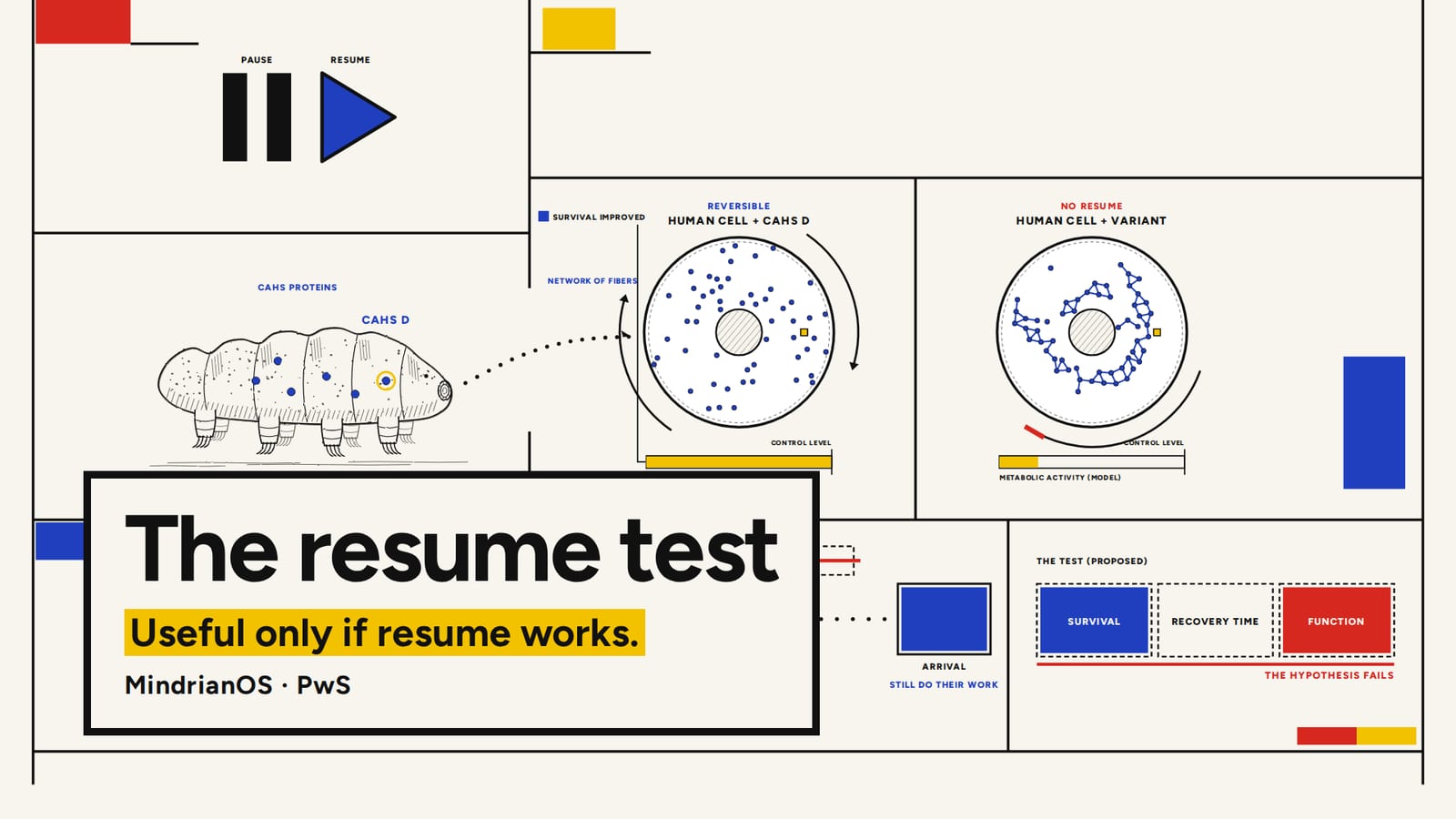
A pause button is only useful if resume works. That sounds obvious until you score a technology. Most evaluation checklists ask whether the capability is real and how mature it is. Few ask whether the system can leave the state the capability puts it in, and still do the job someone needed done.
In The Breakthrough Might Already Exist in the Wrong Field we used a tardigrade protein as a structural twin for organ preservation, and stopped at rung 2 of the evidence ladder. This essay goes back to the same study and asks the question that decides whether any application can climb higher: what happens on the way out?
The problem worth solving
Why do technology evaluations miss the exit?
Because they score the capability, and the capability is the entry. A scout checks that the effect is real, that it is measured, and how mature it is. The buyer, though, never wanted the effect. The buyer wanted a system that still works after the effect has done its part, and that is a different test.
A scouting brief usually reads like a list of properties: it slows metabolism, it survives stress, it gels. Each property is true or false in the source paper, so each one feels like evidence. None of them says what the person on the receiving end has to get done, so none of them can fail on that person's terms.
This is the gap that Say What the Solution Must Deliver, Not What It Is names for products: an outcome is defined by the one who receives it, not by the one who makes it. A protective state is a means. The job sits after it.
What the study showed
What did the tardigrade protein study show?
In a 2024 Protein Science study, human cells engineered to carry a tardigrade protein called CAHS D formed fibre networks under osmotic stress, slowed their metabolism and survived better. When the stress ended, the networks dissolved and metabolic rates returned to control levels.
Demonstrated Tardigrades survive drying by entering biostasis, a reversible pause in life processes, and they rely on a family of proteins called CAHS to do it. The study put one of them, CAHS D, into human embryonic kidney cells grown in lab dishes, then stressed the cells with sorbitol, a sugar alcohol that draws water out of them (Protein Science, 2024; open full text).
Demonstrated Under stress, the protein formed fibrillar networks inside the cells. The cells slowed their metabolism and survived the shock better. The authors also checked which change mattered: keeping cell volume did not correlate with survival, and reduced metabolism did.
Demonstrated After 24 hours of recovery, the networks had resolved and the cells' metabolic rates matched the control cells. In the study's own words: "CAHS D's fibrillar network formation is reversible and metabolic rates return to control levels after CAHS fibers are resolved."
All of this is cultured cells under one kind of stress. It is a measured mechanism in a dish, peer-reviewed, and nothing more.
The variant that stayed paused
What happened to the variant that could not resume?
The same study tested an engineered variant, called 2X Linker, that also formed networks and also slowed metabolism under stress. Its networks did not dissolve well afterwards, and its cells stayed slowed during the recovery period. The pause worked. The resume did not.
Demonstrated The authors put it plainly: condensation and the slowing of metabolism "is reversible for wildtype CAHS D, but that this reversibility is compromised in our 2X Linker variant." The variant forms gels at a lower concentration than the natural protein, so on an entry checklist it would score at least as well.
That is the whole argument in one experiment. Two proteins pass the same entry test. Only one passes the exit test. A scout who scored the capability would have rated them alike.
Producing a protective state is not the same as reliably leaving it.
The reframe
What job would a reversible pause be hired to do?
Take one possible application, and treat it as our proposal, not a result: shipping living research cells between labs. The job is not "slow their metabolism". The job is "deliver cells that still perform their intended function on arrival". That sentence changes what counts as success.
Thesis A lab that receives cells wants them to do what it bought them for: grow, respond, express, behave like the cells in the paper they are trying to reproduce. A slowed metabolism is useful to that lab only for the hours of the trip. After that, it is a cost, unless it reverses fully.
The job sentence also tells you who judges. Not the lab that made the protein, and not the courier. The receiving lab, on its own assay, after arrival. The same move sits under Ninja Got Rich on One-Star Reviews: the job is found in the complaint of the person who used the thing, not in the spec of the thing.
The study does not establish a transport product, organ preservation or any human treatment. This section is a proposed application, written so that it can fail.
The falsifiable test
How would you test the transport idea?
Compare the proposed approach with the current transport method, under realistic conditions, and measure three things after arrival: survival, recovery time and function. If the cells survive but cannot do their intended work, the application hypothesis fails, however good the survival numbers look.
| Measure, and what it answers | Result that kills the idea |
|---|---|
| Survival after arrival: did the pause protect the cells in transit? | No better than the current method |
| Recovery time: how long until the cells are back at control activity? | Longer than the receiving lab can wait, or never |
| Function after recovery: do the cells still do the job they were shipped for? | Survival holds but function is lost (the 2X Linker pattern) |
The third row is the one most proposals leave out, and it is the one the study already warns about. A variant that pauses and does not resume would pass the first row and fail the third.
If you cannot yet say which constraint the application removes, start one step earlier with The Wrong Bottleneck. Here the constraint to remove is loss of useful biological function during handling, and the test measures exactly that.
The scout's test
What three questions should a technology scout ask?
Ask three questions of any capability before you name an application. Does the system leave the state, and how do you know? Whose job is the application, in that person's words? Which single measurement, taken by that person, would kill the application?
- Does it exit? Find the recovery data in the source. If the paper measured only the entry, the exit is UNKNOWN, and you say so.
- Whose job is it? Write the job as the receiver would, as "deliver X that still does Y". If you cannot name the receiver, you have a capability, not an application.
- What kills it? Name the measurement and the result that would end the idea. If no result could end it, it is not yet a hypothesis.
These questions sit on top of the cross-domain search in The Breakthrough Might Already Exist in the Wrong Field. That search finds the candidate. These three decide whether the candidate is worth a pilot. Both guard against the error in Why Most Teams Solve the Wrong Problem: falling in love with the means.
How sure are we
How sure are we about each claim?
Demonstrated
Measured in the study, cultured human cells
- CAHS D formed fibrillar networks under osmotic stress, slowed metabolism and improved survival (Protein Science, 2024).
- Reduced metabolism, not kept cell volume, correlated with survival.
- After 24 hours of recovery, the networks resolved and metabolic rates returned to control levels.
- The 2X Linker variant slowed metabolism too, and its reversibility was compromised: metabolism stayed depressed during recovery.
Thesis
Our claim, not shown
- Shipping research cells is one job a reversible pause could be hired for, and the job is function after arrival.
- The exit test (does it leave the state, and still do the job) belongs in every evaluation of a protective technology.
Unknown
Nobody has answered it yet
- Whether CAHS D, or anything like it, protects cells in real transport conditions.
- Whether cells that resume metabolism also keep their specialised function.
How do you run the resume test on your own technology?
Write the job and the kill result.
A prompt to copy
I am evaluating a technology for a new application. Before we score it, help me write three sentences.
The capability, in the source's own words: [paste one sentence]
1. Does the system leave the state the capability creates? Quote the recovery evidence, or write UNKNOWN.
2. The job, written as the receiver would say it: "deliver X that still does Y".
3. The one measurement, taken by the receiver, whose result would kill the application.
Do not propose the application until all three sentences exist.
The bottom line
When does a capability become an application?
When it completes someone else's job, measured by that someone. A tardigrade protein gave human cells a reversible pause in a dish. That is a real capability, and it is the start of the work. The variant in the same paper is the reminder of why: a pause that does not end is not protection. It is a stop.
Cross-domain innovation starts with a demonstrated capability. Commercialization requires proving that it completes someone else's job.
What do people ask next?
Can tardigrade proteins protect human cells?
In a 2024 lab study, human cells engineered to carry the tardigrade protein CAHS D survived osmotic stress better, with slowed metabolism that returned to normal after recovery. This is cultured cells under one stress, not a treatment or a product.
What is biostasis?
Biostasis is a reversible pause in life processes. Tardigrades use it to survive drying. The study showed a tardigrade protein inducing a similar, reversible slowdown of metabolism in human cells in a dish.
What is the resume test?
The resume test asks whether a system can leave a protective state and still do its job. Score a technology on the exit as well as the entry, and define success by the receiver's job, measured after recovery.
Is cell transport a proven use of this protein?
No. Transport of research cells is our proposed application, written as a test that could fail. The study did not test transport, organ preservation or any treatment.
Sources
- Labile assembly of a tardigrade protein induces biostasis (Protein Science, 2024)Peer reviewedCAHS D forms fibrillar networks in human cells under osmotic stress, slows metabolism and improves survival; the state is reversible; the 2X Linker variant's reversibility is compromised.
- Open full text of the same paperPeer reviewedThe quotations and the recovery measured after 24 hours.