The wrong bottleneck.
How a rocket sled, a mis-wired sensor, and a misunderstood law explain why most innovation aims at the wrong subsystem.
On 10 December 1954 John Stapp took 46.2 G to prove aviation had blamed the wrong component: the body was fine, the seat was the constraint. The same misidentification, the wrong bottleneck, is the most expensive recurring error in innovation, and Murphy’s Law and poka-yoke are its two forgotten correctives.
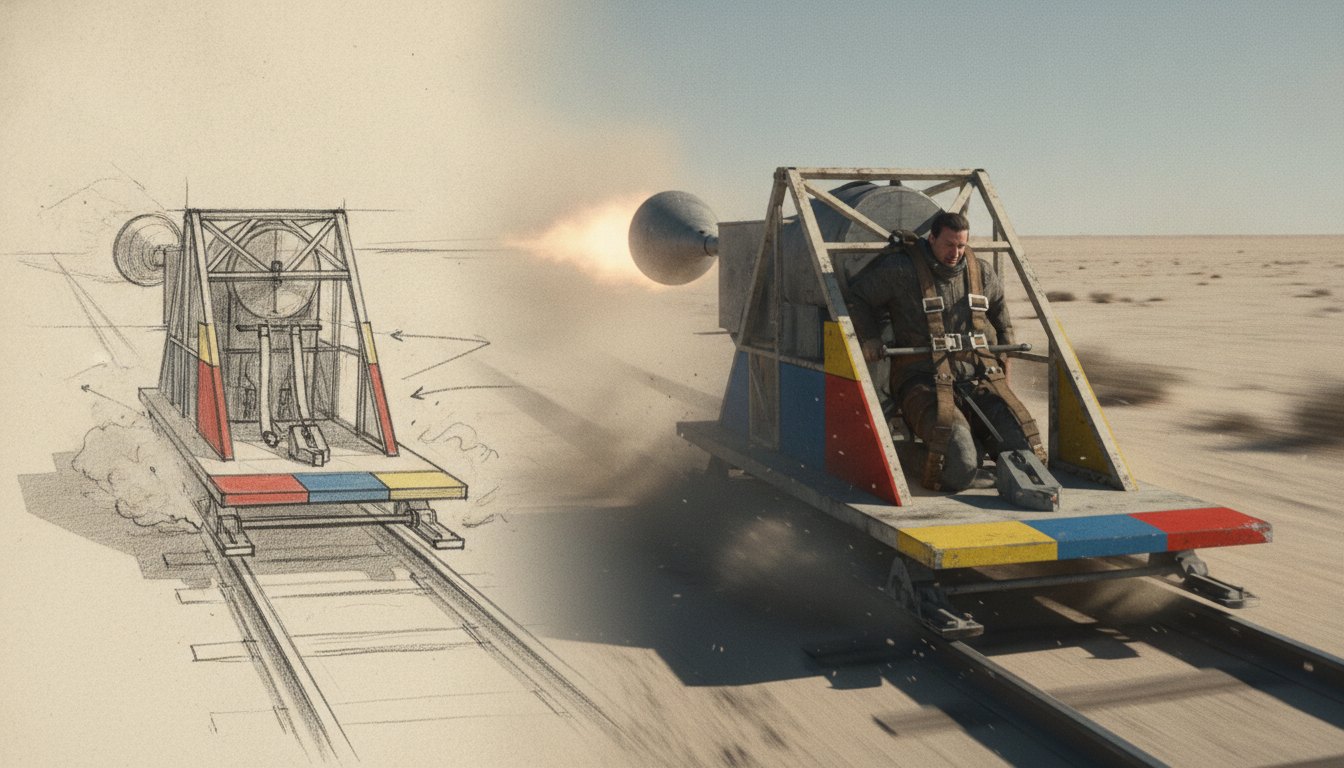
On 10 December 1954, at Holloman Air Force Base in New Mexico, an Air Force physician named John Paul Stapp strapped himself into a rocket sled called Sonic Wind I and accelerated to 632 miles per hour (roughly 1,017 km/h) in a few seconds, faster than a .45 calibre bullet.
Then he stopped. In 1.4 seconds.
The deceleration hit him with a peak force of 46.2 G. The capillaries in both eyes burst; his eyes flooded with blood. On the way to the hospital he lay convinced that one or both retinas had detached and that he would be blind for the rest of his life. By the following day he had recovered enough vision to be discharged. His eyesight never fully returned.
Stapp was not a daredevil, and the experiment was not about speed. He was trying to settle an argument about where a problem was located, and the answer he produced is one of the cleanest demonstrations in engineering history of a specific, recurring, expensive mistake.
The industry was optimising the wrong subsystem.
The verified numbers, in one place.
Every number in this table was checked against the named source at write time (2026-08-19). The one widely repeated figure that failed verification, fifty thousand annual road deaths across the whole 1950s, is corrected in the text below: the toll passed fifty thousand in 1966.
| Fact | Value | Verified against |
|---|---|---|
| Final Sonic Wind I run | 10 December 1954, Holloman Air Force Base, New Mexico | NM Museum of Space History |
| Peak speed | 632 mph, a world land speed record; faster than a .45 calibre pistol bullet | Smithsonian NASM |
| The stop | 1.4 seconds, peak deceleration 46.2 G | NM Museum of Space History |
| Pre-Stapp assumed human limit | 18 G, with cockpit seats engineered to match it | Ejection History archive |
| MX-981 sensor incident | 1949, Muroc Army Air Field, California | Wordorigins.org |
| Earliest “Murphy’s law” in print | Anne Roe, Genetic Psychology Monographs 43:2, May 1951, p. 204 | Wordorigins.org |
| Stapp conference founded | 1955, becoming the annual Stapp Automobile Safety Conference | NM Museum of Space History |
| The 1966 safety acts | Highway Safety Act and National Traffic and Motor Vehicle Safety Act, both signed 9 September 1966 | US BTS |
| Seat belts required in new US cars | From 1968 | NM Museum of Space History |
| US Department of Transportation | Established 15 October 1966; operations began 1 April 1967 | US BTS |
I. The orthodoxy
Why were pilots dying in crashes they should have survived?
Aviation treated a low deceleration limit as a fact about biology, engineered seats only to that limit, and watched pilots die when the seat tore free. The deaths were filed under the body’s fragility, which reconfirmed the limit. An engineering failure had been classified as the wrong problem entirely.
Before Stapp, the working assumption in aviation was that the human body could survive only a modest deceleration, a limit low enough that aircraft seats and restraints were engineered to match it. The number was treated as a fact about biology.
Everything downstream followed from it. If the body gives out at a given load, there is no point building a seat that survives more. So seats were built to that specification, and in higher-energy crashes the seat tore free of its mounting and the pilot died, not from the deceleration itself, but from striking the instrument panel.
Read that sequence again, because it is the whole argument. Pilots were dying from an engineering failure that the industry had classified as a biological limit. The seat was the thing that broke. But the seat was never examined, because the body had already been named as the constraint.
This is not a story about insufficient care. Everyone involved was competent and working hard. They were working hard on the wrong component.
II. The reverse salient, correctly identified
What is a reverse salient?
A reverse salient is the lagging component that caps an entire advancing system. Thomas P. Hughes named it; the uncomfortable corollary is that improving anything else moves nothing. Aviation named the body as its laggard. John Stapp’s sled runs relocated the bottleneck to the seat, where it had always been.
The historian of technology Thomas P. Hughes gave this failure mode its name. Studying how large technological systems actually evolve, he borrowed a term from military history: the reverse salient, the section of an advancing front that lags behind the rest, and which therefore governs how fast the entire line can move.
The insight is uncomfortable and useful in equal measure. A system’s performance is capped by its laggard, not lifted by its leader. Improve anything other than the reverse salient and you have spent real money to move nothing. Worse, the improvement will feel like progress, because something measurably got better.
Which makes correct identification of the lagging component the highest-leverage act available to anyone working on a complex system, and misidentification the most expensive error, because it is invisible from the inside. A team optimising the wrong subsystem looks exactly like a team doing good work.
Aviation had named the human body as its reverse salient. Stapp’s sled runs demonstrated that the body would tolerate far more than doctrine allowed. The real lagging component was the seat, the harness, and the mounting structure: ordinary mechanical engineering, entirely within the industry’s power to fix, and untouched for years because it had been reasoned out of the problem.
Stapp did not discover a new fact about human physiology so much as relocate a bottleneck. That relocation is the innovation.
A team optimising the wrong subsystem looks exactly like a team doing good work.
III. Murphy’s Law, before it became a joke
What did Murphy’s Law originally mean?
Murphy’s Law began as a design rule, not a complaint: if a component can be assembled incorrectly, someone eventually will, so make incorrect assembly physically impossible. Born on Project MX-981’s deceleration tests in 1949, it assigns responsibility to the design, never to the operator’s attention.
Five years earlier and a state away, at Muroc Army Air Field in California, later Edwards Air Force Base, the same research programme produced a phrase that has been misunderstood ever since.
Project MX-981 was running deceleration tests. On one run the sled performed correctly but the instrumentation recorded nothing. A development engineer named Edward A. Murphy Jr., who had designed the strain-gauge sensors, examined the assembly and found that the sensors had been installed the wrong way round.
What Murphy said next is not preserved in any contemporaneous record, and the reconstructions differ. But the engineering conclusion the team drew from it is well attested, and it is the opposite of the fatalism the phrase now carries:
If a component can be assembled incorrectly, eventually someone will assemble it incorrectly. Therefore the engineer’s job is not to ask for more care. It is to make the incorrect assembly physically impossible.
That is a design specification, not a lament. It contains an instruction, a test, and an acceptance criterion. It says: do not put a human being in a position where their attention is the only thing standing between the system and failure, because attention is not a control.
The modern usage, the sigh when the toast lands butter-side down, the shrug when the bus arrives the moment you light a cigarette, inverts it completely. The pop version asks nothing of you and prevents nothing. The engineering version asks the only question that matters: where can this fail, and how do I make that failure structurally unavailable?
The corrective is physical. Make the connector pins different sizes. Make the plug asymmetric. Let the geometry of the part refuse the error, so that no amount of fatigue, pressure, or bad light on a Friday afternoon can produce it.
IV. What we actually know about the name
Who actually coined Murphy’s Law?
The earliest verified appearance of “Murphy’s law” in print is May 1951, in Anne Roe’s study of physical scientists, quoted from a physicist who credited an architect. Printed attributions to the Air Force team begin in 1955-56. Who coined it is unresolved; who sharpened it into a working rule is not.
The provenance is genuinely unresolved, and it is more interesting unresolved than it would be settled.
George Nichols, who led the project, maintained that Murphy received too much credit: that Murphy had complained about a technician, and that it was Nichols and the team who distilled the complaint into a usable engineering rule. Murphy’s side held that the law had been misappropriated and inverted into a joke at his expense. The dispute ran for decades. The definitive account is Nick T. Spark’s A History of Murphy’s Law; notably, Stapp’s own New York Times obituary gives a version of Murphy’s role almost backwards from other tellings.
Then the record complicates further. The earliest certain appearance of the phrase in print is not military at all. It is in a psychologist’s research paper: Anne Roe, “A Psychological Study of Physical Scientists,” Genetic Psychology Monographs, vol. 43, no. 2 (May 1951), p. 204. Roe recorded a physicist stating the principle (if anything can go wrong it will) and naming it Murphy’s law. Her interviews were conducted around 1949, the same period as MX-981.
And the physicist did not attribute it to the Air Force. He said he had been told it by an architect.
The first sustained printed attributions to Stapp’s team come later: Lloyd Mallan’s Men, Rockets and Space Rats(1955), the MATS Flyer in January 1956, the New York Times on 22 January 1956, and the U.S. Navy’s Approach magazine from April 1956.
So the honest position is this: a design principle about the inevitability of assembly error was circulating among people who build things, in at least two professions, at roughly the same moment. Whether the desert team coined it or caught it, they are the ones who sharpened it into a rule and put it to work. That is a more accurate story than a single origin, and a better one, because it suggests the principle was not invented but found, by more than one set of people who had been burned by the same class of failure.
V. Convergence, not lineage
What is poka-yoke, and why does independent convergence matter?
A decade after Muroc, Shigeo Shingo’s poka-yoke, mistake-proofing, reached the same conclusion inside Toyota with no documented contact: put the fix in the artefact, not in the operator’s vigilance. Independent convergence across two engineering cultures is the strongest evidence the principle reflects the problem’s shape.
A decade later and an ocean away, Shigeo Shingo, working within Toyota’s production system, arrived at the same conclusion and gave it a name: poka-yoke, “mistake-proofing.” Design the jig so the part cannot seat backwards. Design the fixture so a missing step halts the line. Never rely on the operator noticing.
There is no documented influence running from a New Mexico test range to a Japanese assembly plant. These are independent discoveries, and that independence is the strongest available evidence for the principle. Two engineering cultures, separated by a decade, a language, and an industry, examined recurring human error and drew the same structural conclusion: the fix belongs in the artefact, not in the operator’s vigilance.
When two traditions converge on an answer without contact, the answer is usually about the shape of the problem rather than the taste of the people solving it.
VI. The second reframe
How did John Stapp reframe automobile safety?
John Stapp’s larger move was redefining the automobile crash problem: the collision is the given, the survivable passenger compartment is the variable. He built the institution that shared crash data from 1955, and the seat-belt requirement for new American cars followed in 1968.
Stapp’s more consequential work came after the sled.
He observed that Americans were not dying in aircraft in significant numbers. They were dying in cars, tens of thousands a year through the 1950s and 60s and past fifty thousand a year by the mid-1960s, at speeds a fraction of what he had personally survived. The manufacturers’ position was that accidents happen and death in a crash is not preventable.
Stapp’s intervention was not a safety argument. It was a problem-definition argument, and it is worth separating the two.
A safety argument says this is dangerous, please be careful. A problem-definition argument says you have named the wrong thing as the cause. The industry had located the problem in the collision. Stapp relocated it to the passenger compartment: the crash is the given, the survivable-volume design is the variable. That is the same move he had already made in aviation: take the thing everyone treats as fixed, demonstrate it is not the binding constraint, and redirect effort to the component that actually caps performance.
He also did something less cinematic and more durable. In 1955 he founded what became the Stapp Automobile Safety Conference, an annual symposium for sharing crash-protection data. Testimony persuades a committee once. An institution that makes findings shareable compounds for decades. For anyone interested in how methodology actually propagates, the conference is the more instructive achievement.
The legislative outcome followed. President Lyndon Johnson signed the Highway Safety Act of 1966 with Stapp present; federal standards required seat belts in new cars sold in the United States from 1968. The Department of Transportation Act was signed on 15 October 1966, and the department began operations on 1 April 1967.
VII. What the methodology graph holds
What does the methodology graph know, and what is it missing?
Queried live on 2026-08-19, the methodology graph holds Reverse Salient and Assumption Challenging in depth, but has no node for poka-yoke. It can diagnose a misplaced bottleneck and challenge the orthodoxy hiding it; it holds no formal move for making the failure impossible. That gap is real, and it is named below.
This article was built against a live knowledge graph of the Problems Worth Solving methodology, and the query is itself informative. (Every node name below was verified against the graph on 2026-08-19; so was the absence.)
Present, and richly so:
- Reverse Salient, carrying Reverse Salient Correction Framework, Identify the reverse salient, Correcting reverse salients by solving critical problems, A Sequence of Reverse Salients, and Reverse Salients Introduction: Spot systemic bottlenecks
- Assumption Challenging, held as a Technique, alongside Riskiest Assumption Test and Challenge Existing Assumptions and Paradigms
- Ill-defined Problems: Challenging Orthodoxies, held as a Course
Those three cover the Stapp story almost completely. The 18-G doctrine is an orthodoxy that went unchallenged because it was never framed as an assumption. The seat was a reverse salient that went uncorrected because the body had been named in its place. The methodology already has vocabulary for both failures.
Absent entirely:
- Poka-Yoke: no node, no alias, no edge.
The graph knows how to find the lagging component and how to challenge the assumption that hides it. It has no formal representation of the corrective move, the design decision that removes the error from the space of possible outcomes rather than asking humans to avoid it.
That gap is worth closing, because the two halves are not the same skill. Identifying a reverse salient is diagnostic. Mistake-proofing is prescriptive. A methodology strong on diagnosis and silent on the corrective will reliably produce teams who can name their bottleneck and then reach for the oldest and worst intervention available: tell people to be more careful.
From the methodology’s own teaching layer · retrieved live from the graph, 2026-08-19
“The most common systems failure in innovation is solving the wrong problem - optimizing a subsystem while the whole system moves in a different direction... This is suboptimization: the part gets better while the whole gets worse. The PWS methodology is a structural intervention against suboptimization.”
VIII. The argument
Why does the demotion of Murphy’s Law matter?
Murphy’s Law was demoted from a problem-definition instrument into a shrug. The original asks where a system can fail and how to make that failure impossible; the pop version licenses inaction. The demotion matters because “be more careful” is exactly the reasoning that kept aviation building seats to a false limit.
Murphy’s Law is a problem-definition instrument that was demoted into a shrug.
In its original form it asks a question with a testable answer (where can this fail, and how do I make that failure impossible?) and it locates responsibility in the design rather than the operator. In its popular form it asks nothing, tests nothing, and licenses inaction. The degradation is not merely a loss of nuance. It is a reversal: a tool for assigning engineering responsibility became a phrase for declining it.
And the failure mode it warns against is the one that killed those pilots. A culture that responds to recurring error with be more careful has accepted a wrong problem definition, precisely the error of designing seats to a limit that was never the real constraint. In both cases the work is sincere, the effort is real, and the improvement is aimed at a subsystem that was not holding anything back.
Stapp’s answer, delivered at 46.2 G with his eyes full of blood, was that the body was not the problem.
The question worth carrying out of it is the one his team wrote down in the desert and the one Toyota rediscovered on the line: not “who made the mistake,” but “what made the mistake possible,” and can it be made impossible?
The four questions people actually search.
What is a reverse salient?
A reverse salient is the lagging component of an advancing technological system, the part that falls behind the rest and therefore caps the whole system's performance. Historian of technology Thomas P. Hughes coined the term. Improving any component other than the reverse salient spends effort without moving the system.
Who was John Stapp?
John Paul Stapp was a US Air Force physician who rode rocket sleds to test human deceleration tolerance. On 10 December 1954 he reached 632 mph and stopped in 1.4 seconds, surviving a peak of 46.2 G. His data demolished the assumed 18 G human limit and reshaped aviation and automobile safety.
What did Murphy's Law originally mean?
Not fatalism. The engineering version, born on 1949 deceleration tests after sensors were installed backwards, says: if a component can be assembled incorrectly, someone eventually will assemble it incorrectly, so the design must make incorrect assembly physically impossible. It assigns responsibility to the design, never to the operator's attention.
What is poka-yoke?
Poka-yoke is Shigeo Shingo's mistake-proofing principle from the Toyota production system: design jigs, fixtures, and parts so an error physically cannot occur, rather than relying on operator vigilance. It independently reaches the same conclusion as the original engineering form of Murphy's Law, a decade later and an ocean away.
You think you know your bottleneck. So did they.
Copy the seed below into a DataRoom. Map the advancing front, question the official constraint, and identify what evidence would show which component is holding the system back.
Copy the question. Fill in your system.
We have a system that is not improving no matter how much we invest, and I suspect we have named the wrong bottleneck.

The system: [DESCRIBE IT IN TWO OR THREE LINES - the product, process, or research program, and the component everyone agrees is the limiting factor].

Here is what makes me suspicious. The official constraint has been the official constraint for years. Everything around it keeps getting better, and the system's overall performance barely moves. When a failure happens, we explain it with the official constraint and move on. Nobody has recently tested whether the named limit is real, and the component that actually breaks first is not the one in the story we tell.

Do not accept my framing. Find the reverse salient: the component that is actually holding the line back. Then stress-test the assumption that named the current constraint, and tell me what it would take to make the failure impossible rather than merely less likely.
Five moves, the laggard first.
Each command is copyable. Every one is a real MindrianOS move, documented in the catalog. The notes track the running example: aviation’s misplaced constraint and the sled that relocated it.
- 1Open a room and paste the system
Question the official constraint: what does the advancing front look like, and which component is actually lagging?
On the Stapp storyAviation's front in 1954: engines, airframes, instruments all advancing, and the seat untouched, because the body had been named in its place.
- 2Run Reverse Salient analysis
Maps the advancing front and hunts the lagging component that caps the whole system, the one whose improvement would actually move the line.
On the Stapp storyThe industry put the bottleneck in the body. Stapp's sled data relocated it to the seat, the harness, and the mounting structure.
- 3Stress-test the named constraint
Devil's advocate on the limit everyone treats as a fact. Is it measured, or inherited? Who last tested it, and with what?
On the Stapp storyThe 18 G doctrine was treated as biology. It was doctrine. Stapp survived 46.2 G and the assumption, not the body, gave out.
- 4Ask what made the failure possible
Trace the recurring error to the design decision that permits it, not the person nearest to it when it fired.
On the Stapp storyMurphy's question, in its original engineering form: not who made the mistake, but what made the mistake possible, and can it be made impossible.
- 5Turn the finding into shared structure
Climbs from one diagnosis to a position your team can defend, act on, and keep testing, filed where the next decision will find it.
On the Stapp storyStapp's durable move was institutional: the conference he started in 1955 made crash findings compound for decades. Testimony persuades once; structure compounds.
Several details that circulate widely with this story could not be corroborated and are deliberately absent above: a specific duration of temporary blindness; a quip about a guide dog; a 1950 press conference at which Stapp named the law. They may be true. They are not, on the available record, documented, and a piece arguing for rigour should not lean on them.
The Murphy-versus-Nichols authorship question is presented as unresolved because it is unresolved.
- New Mexico Museum of Space History, “John P. Stapp”: nmspacemuseum.org
- Smithsonian National Air and Space Museum, “The Man Behind High-Speed Safety Standards”: airandspace.si.edu
- Air Force Test Center, “December 10, 1954: Dr. John Stapp - Testing Pioneer”: aftc.af.mil
- Wordorigins.org, “Murphy’s Law”: wordorigins.org
- Improbable Research, “The 100th birthday of Murphy”: improbable.com
- Anne Roe, “A Psychological Study of Physical Scientists,” Genetic Psychology Monographs 43:2 (May 1951), p. 204
- Nick T. Spark, A History of Murphy’s Law
- Thomas P. Hughes, Networks of Power: Electrification in Western Society, 1880-1930 (1983)
- The pre-Stapp 18 G doctrine and the seat engineering built to it: Ejection History, “Fastest Man on Earth”
- The 1966 acts and the Department of Transportation dates: US Bureau of Transportation Statistics
- MindrianOS Brain: the Reverse Salient and Assumption Challenging structures in section VII, and the poka-yoke absence, were verified by live graph query on 2026-08-19 against the PWS methodology graph, built from twenty years of teaching: docs/brain
Ready when you are. Get MindrianOS. Find your real bottleneck before you fund the official one.
What does this change about your problem?
Bring a hard problem or a load-bearing hypothesis into a DataRoom. Connect the context, question the assumptions, and choose what to test next.