
Ninja got rich on one-star reviews.
A kitchen-appliance company is one of the cleanest case studies in innovation, because it did not invent the blender, the vacuum, or the air fryer. It industrialized the four tools you learn in week four, and turned them into an operating system.
It came up in class, mid-lecture, right after the $170 kettle. Everyone knows Ninja, the kitchen-appliance brand. They took appliances everybody already uses, found exactly where the pain points are, and rebuilt the product around them. The line that stuck: they have a department for locating user needs and pains, attaching it to a big market, and only then developing the product.
That last clause is the whole article. Most companies treat “find the real pain” as a workshop they run once. Ninja, the operating brand of SharkNinja, turned it into a standing function with a budget, a headcount, and a cadence. Same four tools from the methodology. They just ran them on an assembly line.
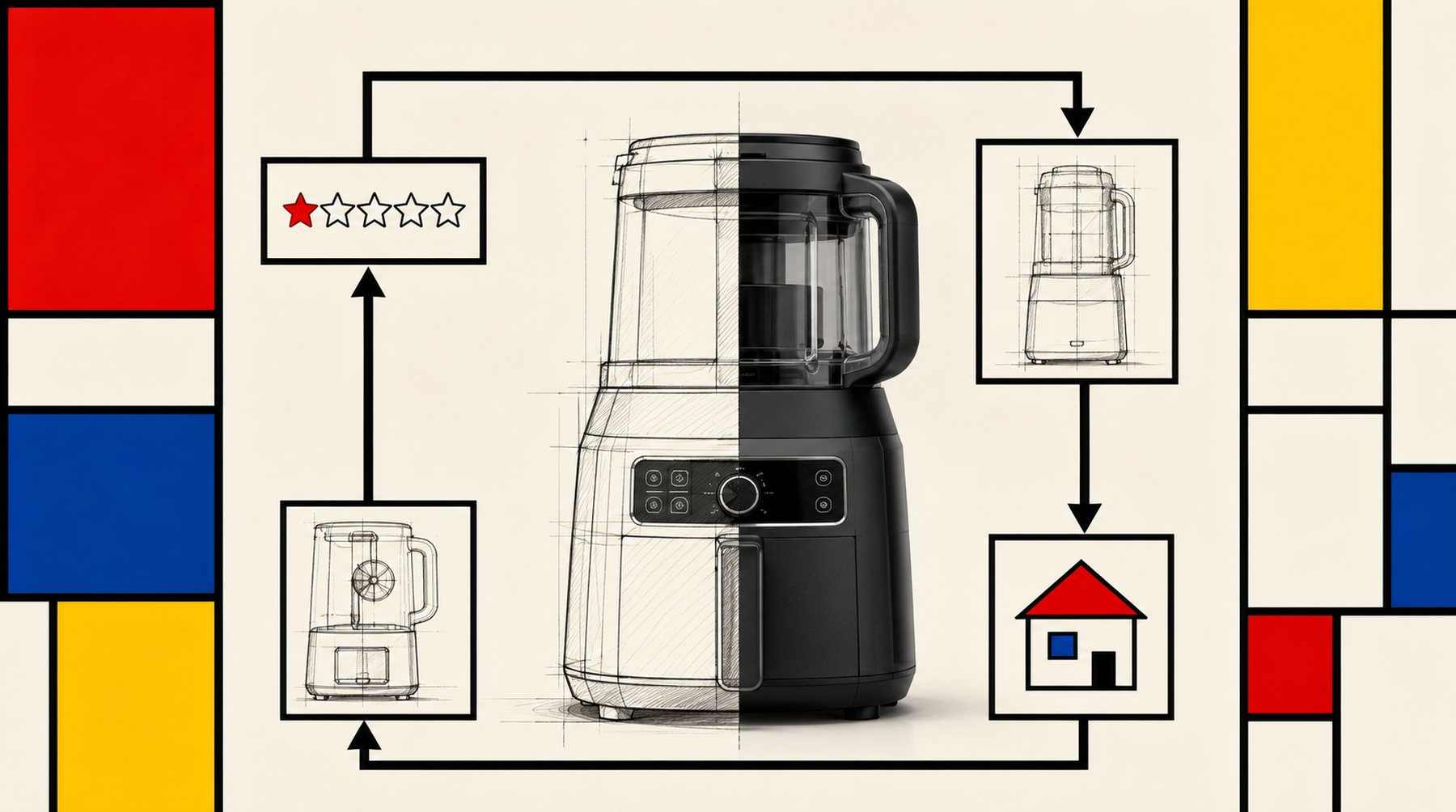
They did not invent a product. They invented the loop.
Look at what they actually ship and you will keep waiting for the breakthrough invention that explains the growth. It is not there. The Shark vacuum launched in 2007 leading with “no loss of suction,” aimed squarely at Dyson. The Ninja blender went after the Vitamix gap. The Foodi fused pressure cooking and air frying. None of it is a category nobody had imagined.
What is genuinely theirs is the machine that produces the products: a consumer-research loop that runs on competitors' complaints, a thousand homes of live testing, three quality gates, and value engineering that keeps the performance and deletes the price. The loop never stops, not even at launch. In their own framing, every day they are gaining loyal consumers or losing frustrated ones, so iteration continues into the field. Reading the signals everyone else skips is a noticing discipline, and the same discipline, pointed at an overlooked anomaly instead of an overlooked complaint, once produced a scientific eureka.
That diagram is the “department” from the lecture, drawn out. Each box is a PWS move. The arrows are the part most companies skip: they run it once and stop.
They invented nothing you could patent. They industrialized the question.
One column is the framework. The other is the factory.
They read the one-star reviews at industrial scale.
PWS says map the process and rate each step on importance and satisfaction; the opportunity is the high-importance, low-satisfaction step. Ninja systematizes exactly that, mining thousands of competitors' negative reviews to eliminate known pain points, then placing every product in roughly 1,000 consumer homes for four weeks before launch and changing it the whole time.
Source · Newsweek, NRF
Three thresholds decide what ships.
About seventy ideas a year get whittled down through hypothesis, prototype, and in-home testing against three internal gates: threshold of acceptability, threshold of excellence, threshold of virality. That is 'stay focused on what really matters' turned into a scorecard a thousand engineers can run.
Source · NRF
The CREAMi did a job a churn cannot.
They took Pacojet's $6,000 professional frozen-dessert technology (its patent expired in 2017) and brought it home at about $200, for the real job: protein, vegan, and low-sugar frozen treats that home ice-cream churning physically cannot produce. They did not invent the machine. They discovered the job and met it at a price.
Source · Serious Eats
A three-question gate before entering any category.
Their chief design officer's filter is almost word-for-word the PWS whitespace test: is there a consumer problem not being solved, can we solve it better and faster, and can we do it at great value? Pass all three and they enter; ~25 ground-up products a year, at least two entirely new categories.
Source · Forbes
The lagging component was price, not performance.
In premium categories everyone optimized the obvious thing: suction, blade speed, motor. The reverse salient was access. A $400 blender is wonderful and out of reach. Ninja attacked the constraint nobody was attacking, near-premium performance at an accessible price, and grew the market underneath the incumbents.
Source · The Valuation Desk
Their moat is the system, not the invention.
This is the part that makes it a real case study. Dyson and iRobot have both sued them as copycats, and head-to-head tests still rank Vitamix above Ninja on raw blend quality. So what did they actually build? Not a better blade. A faster consumer-research-to-iteration loop and relentless value engineering. Exactly the Warby Parker lesson: you do not have to invent anything to change everything.
Source · Bloomberg, Newsweek
The output, in numbers.
~1,000
consumer homes, 4 weeks, before every launch
NRF
$368M
R&D in 2025, about 5.8% of sales
Macrotrends / SEC
1% to 35%
US vacuum share, 2008 to 2019
The Valuation Desk
$30M to $200M
home ice-cream market they created, now ~80% theirs
InnovationLeader
For the full year: about $6.4B revenue, up ~16%, roughly a 20% compound rate over seventeen years, with the company in ~38 categories. Leadership puts them #1 or #2 in every category they enter.
The lesson is not that they out-invented everyone.
It is tempting to write the hagiography. Do not. Competitors openly call them copycats: Dyson and iRobot have both sued them for patent infringement. And in straight performance tests, a Vitamix still out-blends a Ninja. If your thesis is “we will win because our product is technically the best,” Ninja is not your proof.
Their real innovation is the one PWS keeps insisting on: innovation is a problem, a solution, and a business case, and you do not have to invent the solution to win. Warby Parker invented neither glasses nor the postal service. Ninja invented neither the blender nor memory foam. Both changed the user experience and the access, and that changed everything. The thing they built that the incumbents could not copy fast enough was not a gadget. It was the speed and the value of the loop.
Pick a category with a smug incumbent. Run the Ninja move on it.
Copy the brief below into a DataRoom. Map the user experience, look for its limiting constraint, and examine whether a proposed change would be better or simply cheaper.
Bring your category. Mindrian runs the loop.
I want to enter a category that already has strong, established incumbents, the way Ninja entered blenders (against Vitamix), vacuums (against Dyson), and air fryers.

My category: [describe the category you are eyeing, and who the incumbents are].

Ninja's actual method, which I want to run on my category:
1. Mine thousands of one-star reviews of the incumbents to find the step in the user experience that is high-importance and low-satisfaction: the pain everyone has quietly learned to live with.
2. Define the real job the product is hired to do, which is often not the one the category sells.
3. Find the reverse salient: the lagging component holding the whole category back. It is usually price and access, not raw performance (a $400 blender can be brilliant and still unaffordable).
4. Out-engineer that one thing at great value, then put it in 1,000 homes for four weeks and keep changing it after launch.

Help me run this properly. Do not jump to a product. First map the user experience of my category step by step and rate each step on importance and current satisfaction. Then tell me where the incumbents are most hated, what the real job is, and where the reverse salient sits. Be honest with me about whether I would actually be better, or just cheaper.
Six moves, pain first.
Each command is copyable. Every one is a real MindrianOS move, documented in the catalog.
- 1Ignite a room: pick your seat, paste the category and the incumbents' worst reviews
Pick your perspective and bring the category and reviews. Begin with the user experience before naming a product.
What Ninja didNinja begins every product the same way: thousands of competitors' one-star reviews, not an internal focus group. Ignite opens on that input, not on a blank project form.
- 2Map the user experience, rate importance vs satisfaction
The sweet spot is the step that scores high importance and low satisfaction. That is the pain.
What Ninja didA vacuum complaint that hair wraps the brush became 'can we build one that does not wrap hair?' Eighteen months later, the #1 vacuum in the US.
- 3Find the real job, not the category's story
The job a product is hired to do is often not the one the shelf advertises.
What Ninja didThe CREAMi's job was never 'blend faster.' It was healthy, high-protein frozen treats at home that a churn physically cannot make.
- 4Find the reverse salient holding the category back
The lagging component constrains everything. It is rarely the one everyone is optimizing.
What Ninja didIn premium blenders the lagging component was price and access, not performance. Vitamix owned $400. Ninja attacked the $400, not the blade.
- 5Run the three-question category filter
Maps the terms of competition and surfaces the unaddressed problem in the gap.
What Ninja didNinja's design chief gates every category on three questions: is there a consumer problem unsolved, can we solve it better and faster, can we do it at great value? Yes to all, or they do not enter.
- 6The honest check: better, or just cheaper?
Stress-test your own claim before the market does it for you.
What Ninja didVitamix still wins head-to-head on raw blend quality. Ninja's durable edge is the system and the value, not the invention. Know which one you actually have.
- The consumer-research loop, the gates, the funnel. The 1,000-homes / four-weeks testing, the ~70-idea funnel, and the TOA / TOE / TOV thresholds, from CEO Mark Barrocas: NRF.
- Mining competitor reviews; the fast-follower history. Steam mops to a $6.4B powerhouse, Shark vs Dyson, Ninja vs Vitamix: Newsweek.
- The three-question category gate. Chief Design Officer Ross Richardson's whitespace filter: Forbes.
- The CREAMi as a job-to-be-done. Pacojet's $6,000 tech brought home at ~$200: Serious Eats.
- The honest counter-narrative. Copycat lawsuits and the “system, not invention” reading: Bloomberg. R&D spend from SEC filings via Macrotrends.
- MindrianOS Brain. The four-tool framing (user experience mapping, jobs-to-be-done, root cause, reverse salient) and the “you do not have to invent anything” lesson are drawn from the teaching corpus, IRIS 2026, Session 4.
What does this change about your problem?
Bring a hard problem or a load-bearing hypothesis into a DataRoom. Connect the context, question the assumptions, and choose what to test next.