The Butterfly That Remembered
Jo Nagai and the anatomy of a scientific eureka.
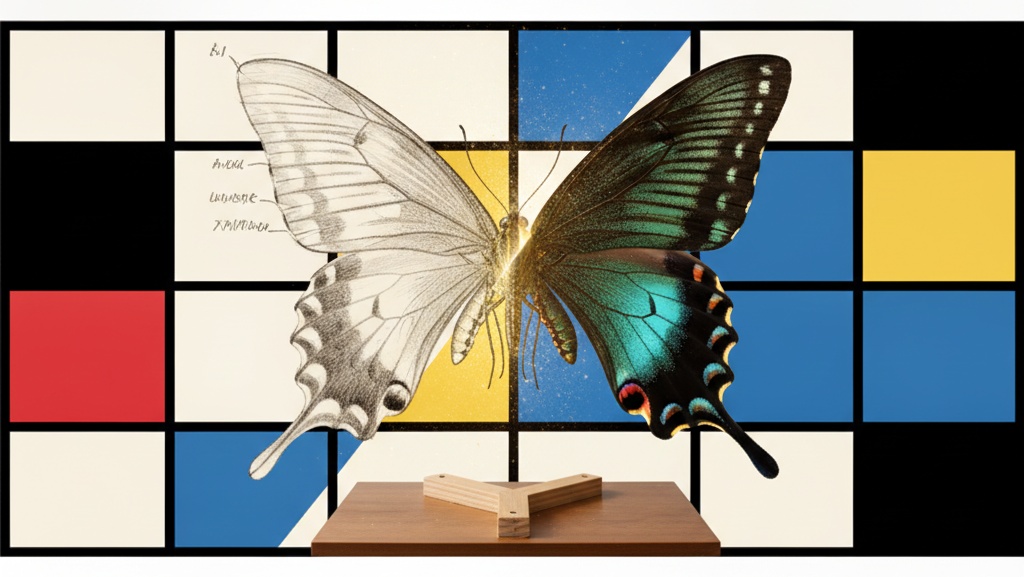
PWS methodology draws a hard line between two kinds of innovation. Directional innovation makes something better, faster, cheaper, along a well-defined dimension, and it rewards expertise. Intersectional innovation puts two unrelated fields together in a way nobody expected, and it needs less expertise, not more, which is exactly why it can be executed by the people you least suspect.
A ten-year-old with a butterfly on his windowsill is about as far from "expert" as science gets. That is not incidental to this story. It is the mechanism.
Overview
This is a story about how a discovery actually happens, not the polished version that appears in a 33-page report, but the raw sequence of cognitive events that leads a young scientist from a nagging anomaly to a result that forces experts to reconsider a century-old biological dogma. It uses the real case of Jo Nagai, a 10-year-old researcher from Kobe, Japan, as the spine of the narrative, but it is also a story about how insight works in the scientific mind, validated by modern neuroscience.
Act I: The Anomaly That Wouldn't Let Go
Every eureka begins not with a thunderbolt but with an irritant: a data point that does not fit the model.
For Jo Nagai, the anomaly was behavioral. Hand-raised Asian swallowtail butterflies (Papilio xuthus), insects he had reared from eggs on his bedroom windowsill, kept flying back toward him after he released them. Wild-caught butterflies fled. This divergence was small enough to be dismissed as noise, but Jo found he could not dismiss it. The anomaly itched.
Scientists who study the phenomenology of discovery call this the preparation phase, the period during which a problem is consciously defined and wrestled with. Preparation is uncomfortable. The mind keeps running into the same wall. Jo had a wall: metamorphosis. Every biology resource he could find said the same thing. The caterpillar's body dissolves into cellular soup inside the chrysalis. The nervous system rewires. Whatever the larva was, its chemical map, its learned associations, its sensory history, should be erased in that liquid crucible.
The wall had a name. August Weismann, the 19th-century evolutionary biologist who proposed that acquired traits could not cross the germline barrier, had essentially put a lock on this entire question. The "Weismann barrier" declared, in its hardest interpretation, that what an organism experiences in its lifetime cannot be written into the biological inheritance it passes on. For over a hundred years, the broader principle, experience does not survive metamorphosis, experience is not inherited, was accepted as settled biology.
Jo had one butterfly that seemed to remember him. And one wall.
Act II: The Paper That Changed the Frame
The preparation phase ends when you find the right prior art. Jo went online and found a 2008 paper by Dr. Martha Weiss at Georgetown University: "Retention of Memory through Metamorphosis: Can a Moth Remember What It Learned as a Caterpillar?"
Reading Weiss's paper was not the eureka. But it was the moment the problem was reframed. What Jo had been thinking of as "my butterfly recognizes me," a vague, almost anthropomorphic intuition, could now be coded as a falsifiable hypothesis: conditioned olfactory avoidance responses, established in the larval stage, persist as measurable behavioral biases in the adult stage, because memory-encoding neural structures (mushroom bodies) are not fully dismantled during pupation.
This is what neuroscientist Mark Beeman, studying the neural correlates of insight at Northwestern University, describes as the critical prerequisite: before the Aha arrives, the brain must find the right framing for the problem. Insights "often come when people have reached an impasse on a problem and must reinterpret or reframe the question." Weiss's paper gave Jo a precise question where before he had only a feeling.
He wrote her a letter. Handwritten. A 10-year-old in Kobe writing to a Georgetown professor, telling her he thought her experimental design had a flaw and proposing a tighter protocol. The audacity of that letter is itself a property of the pre-insight state: once the mind locks onto a problem and reframes it correctly, it acquires unusual confidence in the direction it wants to pursue.
Act III: The Incubation Nobody Sees
Between Jo's letter and his Y-maze results, there is a gap of weeks where the story goes quiet. This is the incubation phase, the most scientifically interesting and most narratively invisible part of any discovery.
Graham Wallas first formalized the idea in 1926, identifying preparation, incubation, illumination, and verification as the four-stage arc of creative problem solving. Incubation is defined as the period when conscious effort ceases but the problem does not. Neuroscience has since built a detailed mechanistic picture of what happens in that silence.
During incubation, the dorsolateral prefrontal cortex gradually loosens its grip on the problem, releasing the fixation caused by prior failed assumptions. The default mode network, active when the mind is not focused on the external world, runs associative searches across memory space, connecting nodes that were too distant to link under focused attention. The hippocampus and striatum continue quietly restructuring the problem's representation. Sleep amplifies all of this.
For Jo, building the apparatus, sourcing the Y-maze materials, calibrating the muscle therapy device to a mild safe current, preparing the lavender-oil stimulus, was the physical correlate of incubation. His hands were busy. His prefrontal cortex was doing what it does when it is not under pressure. The answer was forming.
Act IV: The Moment Itself
Approximately 70 to 80 percent of the trained butterflies chose the scent-free arm of the Y-maze.
In a professional lab, with 300 animals and five graduate students, this result would have been logged in a notebook, run through a chi-square test, and presented at the next lab meeting as a solid replication of the Weiss 2008 finding. Satisfying. Confirmatory. Not transformative.
But Jo had built this experiment alone, on a desk, in Kobe. He had no lab meeting. He had no framework for absorbing the result as routine. And so, when the data pattern became unmistakable, what happened in his brain was what neuroscientists at Duke University and Humboldt University recently documented in detail: a burst of high-frequency gamma activity in the right anterior temporal lobe, followed by a sharp spike of dopamine into the nucleus accumbens.
The right temporal lobe is the brain's region for binding distantly related information, the structure that detects when two ideas that had been stored in separate memory systems actually belong together. The nucleus accumbens is the reward hub, the region that fires for food, for sex, for money, and, as neuroscientist Christian Windischberger has shown, identically for moments of cognitive resolution.
"An Aha!-moment is, therefore, more than just a simple feeling of joy or relief but is a special form of fast retrieval, combination, and encoding process."
Crucially, Duke/Humboldt research published in Nature Communications (2025) showed that insights do not just feel different, they are different, neurologically. The insight condition triggers cortical representational change in the ventral occipito-temporal cortex, and the hippocampus binds that reorganized representation into long-term storage with roughly twice the fidelity of non-insight learning. An aha moment, the research team's own framing put it, "almost doubles your memory."
This is why eureka moments stay with scientists for life. This is why Jo Nagai, a child, produced a 33-page report. The encoding was indelible.
Act V: The Second Discovery, and Why It Hit Harder
The first eureka, memory survives metamorphosis, was confirmatory. Jo had replicated Weiss. Meaningful, but still within the frame of existing literature. The second eureka came from breeding.
Jo raised the next generation of butterflies from trained parents. These offspring had never been exposed to lavender. They had no conditioned learning of their own. And yet, at the Y-maze, they avoided lavender at nearly the same ratio as their parents. Second generation. Third generation. Same avoidance curve.
This is the moment the Weismann barrier cracked. Not in a Nature paper. Not in a funded lab. At a desk in Kobe.
The mechanism Jo had stumbled into is transgenerational epigenetic inheritance, the transmission of behavioral phenotypes across generations not through changes in DNA sequence, but through epigenetic marks. UC Santa Cruz researchers demonstrated in 2022 that the histone mark H3K27me3 can be transmitted through sperm to offspring and to grandoffspring, altering gene expression without touching the underlying DNA code. Jo had independently generated behavioral evidence for this same architecture, in butterflies, without a sequencer, without a mass spectrometer, without a grant.
The Neuroscience of What Just Happened to Him
What Jo experienced across those weeks, mapped against the Wallas model:
What is notable about the verification stage, the one scientists sometimes call the "boring part," is that it is neurochemically anything but boring for the person who has just had the insight. Research shows that insight solutions are remembered far better than analytically derived solutions, and the strength of the memory scales with the subjective intensity of the Aha experience. Jo's 33-page meticulous report, written by a child, is a direct behavioral output of that enhanced encoding.
What the Butterfly's Brain Was Actually Doing
The biological substrate that made Jo's discovery possible lives in the insect mushroom body: a bilaterally symmetric brain structure that serves as the primary locus for associative learning and olfactory memory in Lepidoptera. During metamorphosis, the mushroom body gamma neurons prune their larval-specific dendrites and axons. For decades, this was cited as the mechanism that erases larval memories.
What Jo's data suggested, and what the 2008 Weiss moth study had first demonstrated, is that this reset is incomplete. Recent work in Heliconius butterflies demonstrates that expanded mushroom body size correlates with dramatically enhanced long-term visual memory, suggesting the memory-retention capacity of Lepidoptera is substantially greater than previously modeled. The caterpillar's learned avoidance was not stored in a structure that gets dismantled. It was stored in a structure that gets remodeled, and some of its associative topology survives the remodel.
A Note on Why a Child Found This
The discovery did not happen despite Jo being 10 years old. It happened partly because of it. Prefrontal hyperactivation, associated with anxiety, performance pressure, expert status, actually suppresses the right temporal lobe associations that produce eureka events. Expert scientists often have too much committed to existing models to perceive anomalies as anomalies rather than noise.
Jo had no career risk. He had no lab politics. He had no grant renewals contingent on the model being correct. His brain was running in exactly the attentional mode that neuroscience says is maximally conducive to insight: curious, positive, low-stakes, wandering. He noticed something odd. He let himself be bothered by it. He built the smallest possible experiment that could falsify his hypothesis.
The scientific community's shock was not at the data. The data was clean and replicable. The shock was at being reminded that the most generative cognitive state in science is not the state of knowing. It is the state of noticing that something small does not fit.
Noticing is only the first half of the discipline. The other half is classifying the problem before you reach for a method, the step most teams skip on their way to a polished answer to the wrong question.
Epilogue: The Obligation of Discovery
Dr. Nicholas Christakis, a sociologist at Yale who has described his own first true moment of discovery, watching waves of obesity spread visibly through a social network after five and a half years of computational work, has spoken about what follows a eureka with unusual precision: for a period of time, he was the only person on the planet who actually knew what he had found, a kind of deep insight into the world that was humbling and awe-inspiring in a way that is difficult to describe. He has framed it as an obligation: when a scientist has that feeling of discovery, they have to communicate it to others.
Jo Nagai communicated his discovery in a 33-page report, presented at the 2024 International Congress of Entomology. He was 10 years old. He is, at the time of writing, continuing his study of butterfly grandchild memory.
The butterflies kept turning away from lavender. And the epigenetic marks in their genome kept writing the same instruction into their children, who had never smelled anything but clean air: this scent means danger. Remember. Pass it on.
Science, for once, agreed.
Most people don't get Jo Nagai's luck. They're doing what PWS calls intensive searching, heads-down inside their own domain, and the eureka never arrives because nobody's doing the extensive search alongside it: the broad, patient survey across everything else they already know, looking for the pair nobody would think to check.
That's the actual job of Eureka, the engine this piece is named for. It runs the extensive search a busy person never has time for, scores every cross-domain pair in their own room the way a real opportunity gets validated, and protects the weak-signal tail, the pairs a normal ranked list buries, from getting dismissed the way Jo almost dismissed his own butterfly as noise.
It won't write you a 33-page report. But it will run the search a ten-year-old with a windowsill full of butterflies happened to get right, on purpose, against your own room.
Further reading
- Blackiston, Silva Casey & Weiss, "Retention of Memory through Metamorphosis", PLOS ONE 2008
- "Insight predicts subsequent memory via cortical representational change", Nature Communications 2025
- Strome et al., "Sperm-inherited H3K27me3 epialleles are transmitted transgenerationally", PNAS 2022
- Bline, Le Goff & Allard, "What Is Lost in the Weismann Barrier?", J Dev Biol 2020
- Mark Beeman, Northwestern Beeman Lab, on solving problems with insight
What does this change about your problem?
Bring a hard problem or a load-bearing hypothesis into a DataRoom. Connect the context, question the assumptions, and choose what to test next.