
The Breakthrough Might Already Exist in the Wrong Field
Teams search inside the vocabulary of their own field, so a working mechanism in a distant field never shows up. Name the contradiction, strip the industry nouns until only the functional tension is left, and search for its structural twin. Treat what you find as a candidate, never as proof.
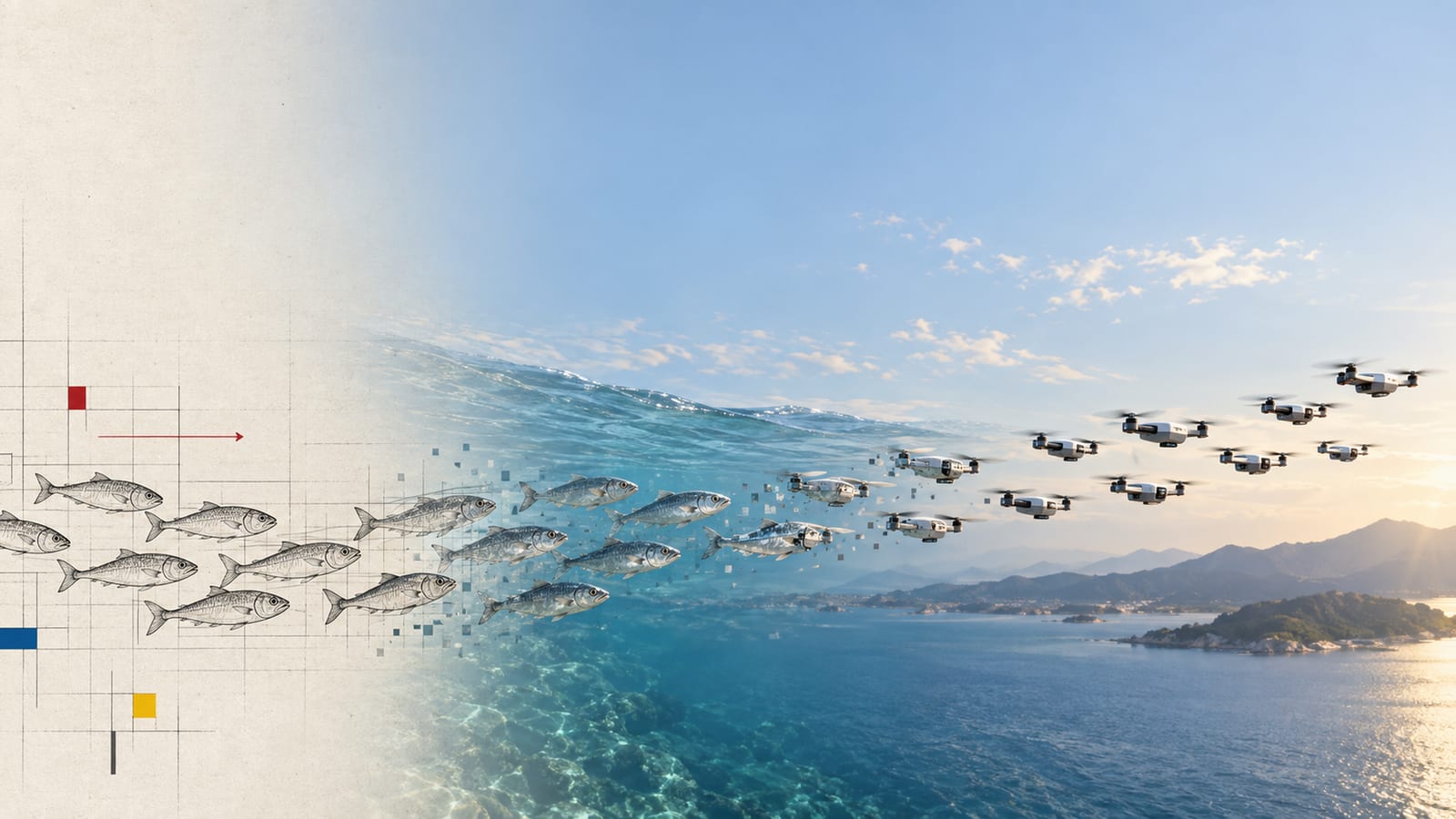
The animal science of 2024 produced some odd results: fish that save energy by swimming together, and a protein that puts human cells into a reversible pause. A Smithsonian Magazine roundup gathered them. We took two of those stories and checked every claim against the papers behind them. In a few places the papers were more careful than the coverage, and we say where.
The point is not the animals. The point is what a team has to do before an animal becomes useful to an engineer: say the problem in words that no single field owns.
Why do smart teams keep rediscovering what another field already knows?
Because they search in their own field’s language. A mechanism that already works in a distant field is written in different words, so the search never finds it. The cost is time spent solving what is already solved, and nobody sees that cost, because nobody sees the answer they missed.
Take a robotics team that wants a swarm to use less energy. It reads robotics papers, swarm papers and battery papers. Every query carries its own field’s nouns. A paper about fish that has the same contradiction at its center shares none of those nouns, so the search engine, the literature review and the team’s own habits all walk past it.
This is a cousin of solving the wrong problem. There, the team misreads the problem. Here, the team reads it correctly and still looks in the wrong place, because it looks where its words point.
The vacuum cleaner story in The Bag Was the Bottleneck ends on exactly this move: delete the function and import it from a field that already solved it. That essay shows what to do once you have the other field. This one is about how you find it.
What is the better question to ask?
Stop asking who has solved your problem. Ask where else this same contradiction exists. The first question searches your field’s vocabulary. The second searches for a shape: something has to get better while something else has to stay true. An analogy search is only as good as the abstraction that comes before it.
You are not hunting for a similar product. You are hunting for a similar tension. A weak abstraction returns neighbors who use your words. A good one returns strangers who face your trade-off.
That makes the abstraction the real work, and it is work you can do on paper before any tool runs.
If you cannot yet say which contradiction to state, find the lagging part first. The Wrong Bottleneck shows what happens when a field blames the wrong component, and When Frameworks Intersect: Reverse Salient in the Wild shows three separate ideas converging on one test for finding the real laggard.
How do you strip a problem down to its functional tension?
PWS (Problems Worth Solving) teaches cross-domain search as two moves in sequence. First name the contradiction: what must improve, and what must stay true. Then strip the industry nouns until only the functional tension remains, and search for its structural twin in a field you would never have searched.
- 1
Name the contradiction. Write what must improve and what must stay true, in one sentence. If the sentence has no "while" or "without" in it, you do not have a contradiction yet. You have a wish.
- 2
Strip the nouns. Delete every word that belongs to your industry. A robot becomes an agent, a battery becomes energy, an organ becomes living tissue. Keep the verbs and the constraint. Stop when a person from any field could read the sentence.
- 3
Search for the twin. Ask where else this tension already exists, and prefer the field you would never have opened. The match you want shares the tension and nothing else.
Here is the move shown on two real questions. Read each row from left to right.
What can a robot swarm learn from a school of fish?
Rewrite “how do we make a robot swarm more energy efficient?” as “how can many independently moving agents reduce total energy use while preserving coordinated motion?” Now fish schools are searchable. In a 2024 PLOS Biology study, giant danio in schools of eight used 63% to 79% less total energy than a solitary fish, at high speed and in turbulence.
DemonstratedThe measurement is real, and it is narrower than the headline. The 79% end belongs to turbulent flow at high speed: at 6 body lengths per second, a school of eight used 21% as much energy as a solo fish, 3.7 against 17.5 kilojoules per kilometre per kilogram, according to the journal’s own commentary. Schools used about the same energy in calm and in turbulent water.
DemonstratedThe paper also measured effort. A solitary fish beat its tail about 22% more. That is tail-beat effort, not energy. Some coverage, including the roundup that started this essay, turns it into “22 percent more energy.” The paper does not say that, so we do not either.
DemonstratedThe setup matters. The fish swam on a water treadmill while a respirometer measured their oxygen use. That is a lab measurement of fish physiology. It is not a measurement of a robot.
PlannedPress coverage floats the idea that drones or swimming robots could copy the effect. Nobody has shown a robot saving energy this way in this study.
ThesisOur claim is smaller than the press idea. A school of fish is a candidate twin for the swarm question, and it is worth an engineer’s afternoon. It is not a result.
What can organ preservation learn from a tardigrade?
Rewrite “how do we preserve organs for transplant?” as “how do we keep living tissue viable at near-zero activity, then restore normal function?” Now a tardigrade protein is searchable. In cultured human cells, that protein gelled the cells and slowed their metabolism, and the effect reversed when stress ended.
DemonstratedThe result is in cell culture only. The protein, called CAHS D, was put into human cells in lab dishes (Protein Science, March 2024). It slowed metabolism, made the cells more resistant to stress, and the effect reversed when the stress ended. Slow down, survive, come back: that is the shape of the rewritten question.
DemonstratedA second paper (PLOS ONE, January 2024) looked at how the animal does it. The form a tardigrade takes under stress, called a tun, depends on reversible oxidation of cysteine. Reactive oxygen species oxidise cysteine thiols, and blocking that stopped tun formation under salt or sugar stress. It also removed survival of freezing. The roundup paraphrases this loosely, so we cite the paper.
PlannedThe leap to transplants is a hope, and the authors say so. The lead author has floated pausing tissue decay for organ transplant or trauma care. The study’s own conclusion points to technologies built on inducing biostasis, and to cell storage. No organ has been preserved this way. The lead author also said this is not about preserving whole humans.
ThesisOur claim: a protein that makes living cells pause and resume is a structural twin of the organ-preservation question. That earns it a look. It does not earn it a promise.
How much should you trust an analogy?
An analogy is a candidate worth investigating, never evidence that a transfer will work. Five rungs separate an observed phenomenon from a working solution. Say which rung each claim stands on, and the reader knows how much weight it can carry.
On this site’s labels, rungs 1 and 2 are DEMONSTRATED, rungs 3 and 4 are THESIS, a researcher’s stated plan to test rung 4 is PLANNED, and rung 5 is UNKNOWN until someone runs the test.
| The rung | Fish schools to robot swarms | Tardigrade protein to organ preservation |
|---|---|---|
| Demonstrated1. The phenomenon exists in the source field | Giant danio in schools of eight used far less total energy than a solitary fish. | A tardigrade protein gelled human cells in lab dishes and slowed their metabolism, reversibly. |
| Demonstrated2. The mechanism is described or measured there | Oxygen use and tail-beat effort, measured on a water treadmill. | Tun formation depends on reversible cysteine oxidation, and the protein's effect reverses when stress ends. |
| Thesis3. The analogy looks relevant to your problem | Moving together might cut a swarm's total energy use. This is a candidate. | Near-zero activity, then restored function, is the same tension. This is a candidate. |
| Thesis4. Transfer might give a useful solution | PlannedA swarm that copies schooling might save energy. Only press coverage says so, and no robot was shown. | PlannedPausing tissue decay for transplant or trauma care might become possible. The lead author names it; no organ has been preserved this way. |
| Unknown5. It survives your field's constraints | Not known: a robot's medium, sensors and communication limits are different from a fish's. | Not known: whether anything survives the jump from cultured cells to a whole organ. |
Notice where both examples stop. Each reaches rung 2 in its own field. Rung 3 is our reading. Rungs 4 and 5 are open, and they stay open until someone builds the thing.
How can this kind of search go wrong?
It fails in two ways. You never find the distant analogy, because the search stayed inside your field’s words. Or something invents a plausible analogy and presents it as found. The first costs you the breakthrough. The second costs you trust, and it is harder to notice.
The second failure is the newer one. A language model can write a fluent paragraph about how a coral reef is like your supply chain. The paragraph reads exactly like a real finding. Nothing in it tells you whether any source stands behind it. A polished first build can do the same thing in software: it can look like evidence before anyone has tested it. When Everyone Has a Power Ring follows that trap through AI-assisted coding.
Mindrian is built against both. The first failure is answered by running the search and counting what comes back, zero included. The second is answered by making the tool say what it did not do.
A plausible analogy and a found analogy read exactly the same until you ask for the source.
How sure are we about each claim?
- Giant danio swimming in schools of eight used 63% to 79% less total energy than a solitary fish, at high speed and in turbulence. The 79% end is the turbulent, high-speed case (PLOS Biology, 2024; scope from the journal’s commentary).
- The fish were measured on a water treadmill with a respirometer. It is a lab measurement of fish physiology, not of a robot. A solitary fish’s extra 22% is tail-beat effort, not energy.
- A tardigrade protein, put into human cells in lab dishes, gelled them, slowed their metabolism and made them more resistant to stress, and the effect reversed when stress ended (Protein Science, 2024). Cell culture only.
- Tun formation depends on reversible cysteine oxidation, and blocking it stops tun formation under salt or sugar stress (PLOS ONE, 2024).
- On 6 October 2026 /mos:find-analogies ran on two real rooms and returned candidate pairs with a structural signal, plus a line saying what the run could not do. That shows the command runs and reports its limits. It does not show that any pair transfers.
- Press coverage floats the idea that drones or swimming robots could copy schooling. No robot was shown to save energy this way in the study.
- The lead author of the tardigrade work names pausing tissue decay for transplant or trauma care as a possibility. The study’s own conclusion points to biostasis technologies and cell storage. No organ has been preserved this way.
- Fish schools are a structural twin of the robot-swarm energy question, and a tardigrade protein is a structural twin of the organ-preservation question. Each is a candidate worth an engineer’s time. Neither is evidence that the transfer works.
- The design target is one of four verdicts for each candidate, with the evidence behind it: found, candidate, rejected, or it could not. This is a design target, not shipped. The command does not issue these verdicts today.
- Whether schooling survives a robot’s medium, sensors and communication limits.
- Whether anything survives the jump from cultured cells to a whole organ.
How do you run this on your own problem?
Take one problem. Rewrite it without industry nouns. State what must improve and what must remain true. Run /mos:find-analogies. Then read the result, starting with the line every run report carries that says what the run could not do.
- 1
Take one problem, ideally the lagging part of your system. If you do not know which part lags, run /mos:find-bottlenecks first.
- 2
Rewrite the problem with every industry noun removed.
- 3
Write what must improve and what must stay true, in one sentence.
- 4
Run /mos:find-analogies on that sentence.
- 5
Read the result. Start with the line that says what it could not do. Then place each pair on the ladder: which rung is it on? Treat every pair as a candidate.
Write the sentence with the nouns stripped out.
I want to find out whether my problem is already solved in a field I would never have searched.

My problem, in my own field's words:
[paste one sentence]

Help me do two things before any search runs. First, write what must improve and what must stay true, in one sentence that has a "while" or a "without" in it. Second, rewrite that sentence with every industry noun removed, so a person from any other field could read it.

Show me the rewritten sentence and ask me whether it still means my problem. Do not search yet.
Two commands, the second one is the point.
Each command is copyable and documented in the catalog.
Optional. Find the lagging component so you state the right contradiction.
Look for the structural twin. Read the “It could not” line before you read the pairs.
Where should you look for the breakthrough?
Not in the field that owns the problem. In the field that owns the tension. Your problem has a shape, and that shape may already live somewhere you have not looked. Finding it is a search problem with a direction, and the direction comes from the sentence you wrote with the nouns stripped out.
A breakthrough does not always need a new idea. Sometimes it needs the discovery that your problem is already solved somewhere you would never have searched.
What do people ask next?
What is a structural twin?
A structural twin is a system in another field that faces the same contradiction as your problem: something has to get better while something else has to stay true. It shares none of your industry's nouns. It shares the tension.
Does the fish school result mean drones will save energy?
No. The study measured giant danio swimming on a lab water treadmill, not robots. Press coverage floats the idea that robots could copy the effect, but nobody has shown a robot saving energy this way in that study. It is a candidate worth investigating.
Can tardigrade proteins preserve human organs?
Not yet, and nobody has shown it. A tardigrade protein slowed metabolism in human cells in lab dishes, and the effect reversed when stress ended. Use for organs or trauma care is a possibility the lead author names, not a result.
Does /mos:find-analogies tell me an analogy is correct?
No. It returns candidate pairs, each with a structural signal, and a line saying what the run could not do. It does not test a candidate against your problem's constraints, so judging the match stays with you.
- Starting point. The Smithsonian Magazine roundup of 2024 animal discoveries: article. We used it to find the stories and the primary papers below to check them.
- Fish schools. PLOS Biology 22(6) e3002501, 6 June 2024: the 63% to 79% figure, the 22% tail-beat effort, and the water treadmill with a respirometer: paper.
- Fish schools, scope. PLOS Biology 22(6) e3002677, 7 June 2024, the journal’s commentary: the turbulent, high-speed case at 6 body lengths per second, 3.7 against 17.5 kilojoules per kilometre per kilogram: commentary.
- Tardigrade protein in human cells. Protein Science, 19 March 2024, DOI 10.1002/pro.4941: paper.
- Tun formation and cysteine oxidation. PLOS ONE 19(1) e0295062, 17 January 2024: paper.
- What the command does. The statement that /mos:find-analogies ran on two real rooms on 6 October 2026 and returned candidate pairs with a structural signal, plus a line saying what it could not do, comes from that run. The command page is in the catalog.
What does this change about your problem?
Bring a hard problem or a load-bearing hypothesis into a DataRoom. Connect the context, question the assumptions, and choose what to test next.